Thursday, November 17, 2005

Desperate Martin Plays Religion Card from Bottom of Deck

Had to laugh when I saw Bourque highlight a CTV web report that had Martin issuing a warning from Asia to the opposition leaders:

“When you are talking about the holiday season, there are also other religions that have different New Year’s at different dates and their holidays at a different date and I think we have to be respectful of that -- the orthodox churches, for example,” he said.

This from a leader who, upon changing his mind on same-sex marriage, pleaded a distinction between his own religious beliefs and his conduct as a politician.

This from a party whose attack dog Warren Kinsella mocked the religion of Stockwell Day during the 2000 election.

Most significantly, this from the leader of a party that called the 1997 election on Sunday, April 27: Orthodox Easter Sunday! (The election was June 2.)

Finally, where was the Liberals’ concern for Christmas – Orthodox or otherwise – when they brought down the Clark government on December 13, 1979?

Orthodox Christians are not accustomed to receiving any special regard for Julian calendar holidays from their government, schools or workplaces. Now the first time that we get some, it comes from a desperate Liberal clinging to power. Shove it back up your chimney, Paulie. Don’t soil my religion by using it as a prop now that you’ve lost Jack Layton.

Monday, November 14, 2005

Maybe teacher unions should focus on bullying of children

In a case of bad timing and bad taste, the Ontario English Catholic Teachers Association (OECTA) and Ontario Secondary School Teachers Federation (OSSTF) chose to go ahead today with a news release “calling on government and school boards to work with them to confront workplace bullying” based on the results of phase 2 of their Bullying in the Workplace Study.

The release came out in the late morning on the same day that the Globe and Mail is carrying a front-page Christie Blatchford piece about 18 months of sexual harassment and assault allegedly suffered by a 16-year-old girl at a Catholic high school in northwest Toronto (online subscription required). To be fair, it appears that the harassment was not reported to teachers, and Blatchford notes that it came to light when a teacher intervened on overhearing the girl being harassed in a hallway.

OECTA and OSSTF note in the release that they are using their survey to advocate not only on behalf of bullied teachers, but bullied workers everywhere. In September they released a survey on teacher bullying by students. Nowhere in their two-part study do they talk about bullying of students by students.

On a related note, in Saturday’s National Post there was a story about how Ontario education minister Gerard Kennedy is looking into the fact that some school boards are allowing teacher unions to administer his $500-per-education-worker payoffs, er, “Teacher Development Accounts.” This $80-million kitty was offered to unions as an inducement to agree to four-year collective agreements to ensure that the McGuintyites would have no labour problems in schools until after the 2007 election. The Post reports that “there is little uniformity between boards on how the non-taxable benefits are distributed -- or even the amount.”

So Kennedy offered the unions a bribe, and now he’s shocked that they’re treating the money as a slush fund? Kennedy’s surprise belongs to the same category as Captain Renault’s shock that gambling was taking place at Rick’s in Casablanca. And the Liberals’ special relationship with teacher unions will ensure that nothing will come of Kennedy’s investigation.

Iraq Reality Checks

For a reality check on the “Bush lied, people died” cant, check out Norman Podhoretz’s “Who Is Lying About Iraq?” in December’s Commentary.

For a reality check on “the Iraqis don’t want Americans there,” check out the “Thank You” commercial at The Other Iraq.

Wednesday, November 09, 2005

“Toxic Nation” or Junk Science?

One of the top items on CTV last night was an Environmental Defence report to be released today purporting to show that Canada is a “toxic nation” because “Canadians are walking around with a cocktail of harmful toxic chemicals in their bodies” (CTV News website). The story also appeared in The Globe and Mail.

But the “report” is based on blood and urine samples taken from a grand total of 11 people, including: Dr. Kapil Khatter, head of Canadian Physicians for the Environment; Merrell-Ann Phare, Legal Counsel and Executive Director of the Centre for Indigenous Environmental Resources; and David Masty, Chief of the Whapmagoostui First Nation

Wasn’t there a song that went, “a doctor, lawyer and an Indian chief couldn’t love you as much as I do?” Now we know why: it’s hard to get in the mood when PCBs and heavy metals are weighing down certain vital capillaries.

But seriously, the point here is that established media outlets should know better than to give such prominent play to a report that, besides coming from an environmental advocacy group, has little if any scientific value because it surveyed only 11 people. Such reports should get no more than a digest item in the print media. As for TV and radio newscasts that already have a hard time squeezing a lot of news into very little time, this report shouldn’t have even made the line-up.

Props to Andre Picard of the Globe for at least getting a comment from Health Canada:

Health Canada spokesperson Paul Glover said: “It’s only 11 people. It’s not statistically significant . . . but it is an indication and we will take a look at it.” . . . Mr. Glover said “obviously Canadians will be somewhat concerned. They didn’t choose to put chemicals in their bodies. So how did they get there? But for Health Canada the question is: What is the level of risk?”

With the rise of more and craftier advocacy groups, think tanks and PR strategies (and, if you believe it, the “death” of advertising), the media’s task of determining what is real and relevant is becoming harder at the same time that it is becoming more important. But surely they can do better than getting played by an advocacy group pushing a study of only 11 people?

What’s worse is that the media is not above playing these sketchy survey games themselves. In 1997, the Atkinson Foundation (i.e. The Toronto Star) funded “Speaking Out,” a study by the pink tank Caledon Institute. According to the paper setting out the study’s description, research strategy and methodology (available at http://www.caledoninst.org/ -- search publications for “speaking out”):

The Speaking Out Project was established in January 1997 to document the effects that policy changes are having on ordinary people in Ontario, especially those with low incomes. The project is a longitudinal study of 40 Ontario households, which will be interviewed intensively at six-month intervals until the year 2000. To supplement and interpret the households’ experiences, Speaking Out also analyzes a wide range of other sources of information. We will report our findings after each round of interviews.

The institute defended limiting the study to only 40 households (page 4):

We considered a number of different factors when deciding on our sample size. Too many households would have made proper tracking difficult and too costly; too few would have meant insufficient coverage of various characteristics. We decided that a sample of 40 households allowed adequate coverage of demographic and other characteristics, was manageable and accommodated the expected withdrawal of some households from the project.

Later on in the document, they reveal this little nugget (page 5):

While the smaller sample size means that we cannot automatically generalize our specific findings from these 40 households to all others in Ontario with similar demographic profiles, a range of complementary surveys and other types of studies and databases are available for our use. When the issues we explore overlap with other studies, that data will be investigated to see if generalization is possible. Thus, our analysis and reports will reflect a multimethod research approach.

By my reading, this means “our basic research is useless because our sample is too small, but we’re going to pad it out with other research we find if it confirms what our original useless research shows.”

No matter. In October 2000, The Toronto Star’s Caroline Mallan reported that the Speaking Out project had found that, despite Ontario’s economic boom, nearly half the households in the study group were worse off than they were in 1995, and another quarter of them were about the same. (I’m guessing that over a quarter of them were therefore doing better, but the Star’s story does not provide the remaining figures.)

The Star reported that the institute “melded its findings with Statistics Canada data to come up with a picture of low income people struggling to pay the bills” but since the referenced report is apparently not on the institute’s website, it’s not clear what data was “melded” or how. Could they have used StatsCan demographic data to generalize their findings, i.e. exactly what they said they couldn’t do on page 5 of their methodology?

Turning back to the toxic pretenders, I don’t know whether I have heavy metals or PCBs in my body, but I can say without benefit of a blood sample that the authors of Toxic Nation are overflowing with one unpleasant substance. I look forward to see whether “Toxic Nation” makes it into the Financial Post’s annual Junk Science Week next year. It certainly merits consideration.

Tuesday, November 08, 2005

Phony Health Care Debate Gets Phonier

When I blogged on the Supreme Court’s Chaoulli decision in June (see June 2005 Archive), I wrote:

As for the honest, realistic debate that many hope will be spurred by this ruling, I’m not holding my breath. The Supreme Court is unlikely to wipe away the health care delusions of Canadians, when a decade of declining services and increasing waiting lists have done nothing but reinforce those delusions.

As if on cue, here’s Jack Layton to inject a fresh shot of poison and distortion into the health care debate, by demanding – as the price of continuing to prop up the Martin government – that the federal government ban “double dipping” by doctors.

The term “double dipping” has until now generally been limited in its use to politicians who are drawing two government paycheques, such as a politician receiving an MPP pension plus an MP’s salary after having been elected to the federal Parliament. But The Toronto Star provided this definition in a November 3rd story, “Liberals draft health deal for Layton”:

Double dipping refers to a practice in which some doctors offer patients the same services in the insured public system or more quickly in private clinics for higher fees. Some medicare advocates have been urging Ottawa to guarantee that the public health system be kept completely separate from privately delivered services.

Although the practice of double dipping is not widespread, both Layton and Dosanjh have expressed concern about it and Layton, in his talks with the Liberals, has been demanding a ban on it in the Canada Health Act. Such a provision would head off any future attempts by the provinces to allow it.

Not widespread? I’ve never even heard of it until now. Frankly it sounds like another Lib-left bogeyman not unlike “extra-billing” in Ontario in the 1980s. Banning so-called extra-billing was one of the concessions Bob Rae extracted from David Peterson to catapult Peterson from opposition leader to the Premier’s Office in the minority Parliament that was the result of the 1985 election.

A doctors’ strike ensued, during which The Star ran a now-infamous editorial cartoon depicting doctors as pigs at the trough. The Peterson government eventually prevailed in banning extra-billing, however, and the province’s relations with doctors have been poisoned ever since.

The fact is, in many industrialized countries that have public health care, one of the things that makes it work is allowing doctors to work in both government facilities and private ones. But Layton will have none of this, nor will Sid Ryan, Tommy Douglas’ daughter, the health care unions, and the others who are too heavily invested in the Cuban model of health care to see reality.

One reality is that while the federal government can pass whatever laws it wants, it has little financial leverage over provincial governments to impose those laws. Since it gave up tax points to the provinces in the 1980s, all it can do is withhold cash transfers, which in many provinces account for less than 20% of their health budgets. Wealthy provinces can simply tell the feds to take a hike, as they could well afford whatever clawbacks the federal government imposes under the new law.

Friday, November 04, 2005

Money Still Rolling Despite Shaky Polling

Conservatives who have been through the sponsorship spin cycle before know better than to get too high on the Ipsos-Reid poll showing the party roughly tied with the Liberals both nationally and in (cue harp music) Vote Rich Ontario. Sponsorship revelations have been made before; polls have climbed before; and polls have come down before.

One set of numbers that should give comfort, however, is the third-quarter financial returns of the federal political parties, as posted by Elections Canada today. They show that the Conservative Party continues to out-fundraise the Liberals by more than 2-1.

Third Quarter (July-September 2005) Contributions

Conservative Party: $3,247,131 from 32,714 contributors
Liberal Party: $1,062,332 from 6,943 contributors

2005 Contributions to Date (January-September)

Conservative Party: $10,807,275 from 107,457 contributors
Liberal Party: $4,194,591 from 20,873 contributors

If the sponsorship scandal has effectively scared the Liberals off of attempting to supplement their campaign budgets with misappropriated taxpayer dollars, then in the next election they will be limited to spending only what they raise and what they can convince the banks to lend them.

If I may offer one spin line, however, it is this: Liberals and others have tried to put the money stolen from the sponsorship program in the context of the government’s overall budget, in which it is very small. The proper context, however, is the amount of money parties raise on an ongoing basis and spend during an election. In that context, $1.14 million, $5.4 million, $40 million, or whatever the Liberals stole, is huge – as the results of the 1997 and 2000 elections proved.

Correction and Apology

On November 3 I posted an item about former Montreal Canadiens coach Jacques Demers. It is former Ottawa Senators coach Jacques Martin who married Maureen McTeer’s sister, not Jacques Demers.

My apologies to everyone involved.

Tuesday, November 01, 2005

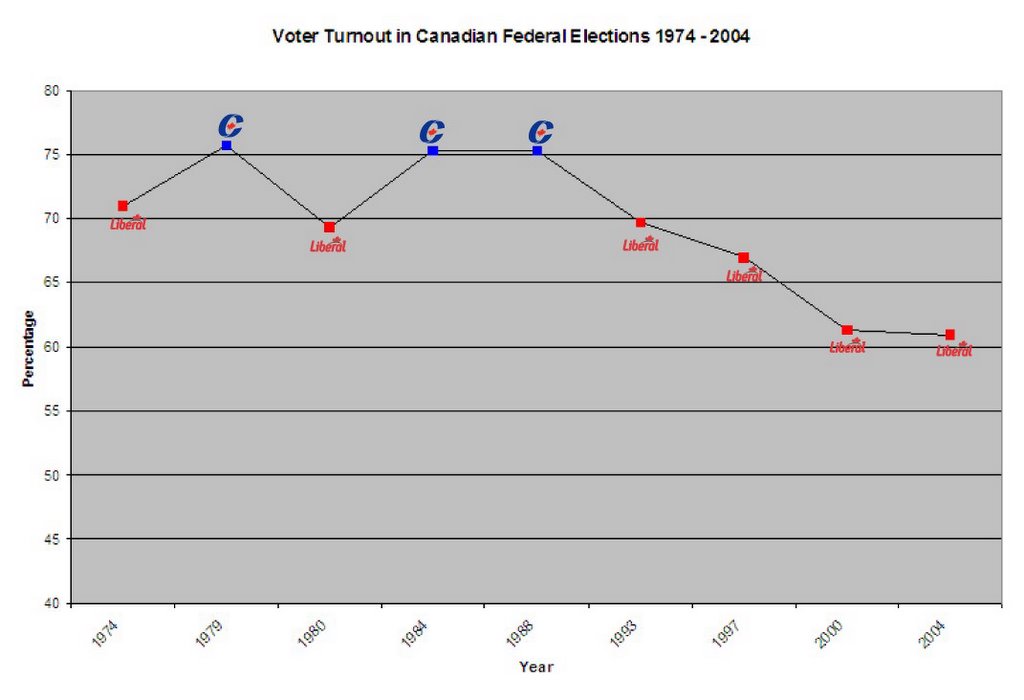
High Turnout Good for Conservatives, Says Organization Guru

While the corruption in the Liberal party is an important narrative, it is crucial for conservatives to, in one of Brian Mulroney’s favourite maxims, “keep your eye on the ball.”

Richard Ciano is one of the conservative party’s Ontario vice presidents and a friend. He notes in his latest newsletter that:

Many Conservatives have been conditioned to believe that high voter turnout favours the Liberals. But by every objective measure that turns out to be false. With only a few exceptions over the last sixty years, conservative parties in Canada, the United States, and Great Britain have seen greatest electoral success when voter turnout is high.

His argument is illustrated by graphs such as these (click to view full size).


Ciano is also doing some great behind-the-scenes work in passing on his expertise and that of others, helping conservatives across Ontario organize and prepare for the next election through the Conservative Campaign Academy.

Monday, October 31, 2005

A Definitive Take on the Plame Affair . . .


. . . will not be found on this blog. I don’t know whether Valerie Plame was a covert CIA operative when Robert Novak revealed her identity in 2003.

I don’t know why the CIA though it was a good idea to send her WASP husband – a former ambassador to Gabon and acting ambassador to Iraq prior to the first Gulf War – to Niger to try and confirm reports that Saddam Hussein had tried to buy uranium for his nuclear program. (But if Nick and Nora Charles are the CIA’s template for secret agents, it explains a lot about the quality of their intelligence in recent years.)

I don’t know if Bush administration officials leaked her identity, or were merely trying to discredit her husband’s criticisms of the Iraq War and blowing her “cover” her was unintentional.

All I can say for sure at this point is that anybody who puts out a book with this cover is someone whose conceit is beyond satire.

Star Digging Into Sorbara/Royal Group

The Toronto Star has been doing some digging into the Sorbara/Royal Group affair, the result being several stories in the Saturday Star. On page A8, Kevin Donovan – who usually works on big investigative stories – reports that Sorbara increased his holdings in Royal Group Technologies shares over his 10 years as an independent director. (N.B. I cannot link to these stories; you have to go to the Star’s website and search for “Sorbara”)

This fact casts doubt on Sorbara’s most recent spin on his years at Royal, which was that he had serious concerns “from Day 1” over the freedom Royal Group’s management had from board oversight. As I noted on October 17, Sorbara’s original spin in March, 2004 – when the RCMP, OSC and Canada Customs investigations into Royal first became public – was that he “wasn’t aware of any problems” when he was being vetted for cabinet in the fall of 2003.

Saturday’s Star has two more stories on Royal Group in the business section, one of which notes that Scotiabank, banker for Royal Group and the St. Kitts resort being built by Royal founder Vic De Zen, conducted an internal review to ensure the bank wasn’t being used for money laundering. A Scotiabank memo seen by the Star notes that the accounts for the resort and a Royal subsidiary were frozen in September and October 2003. Sorbara was a Royal Group director until October 2003. Was he ignorant of the frozen accounts, or did he know and simply choose not to tell McGuinty’s cabinet vetting team?

The article ends with a bizarre quote from the contractor for the St. Kitts resort, saying he never saw anyone putting cash into any of the containers of Royal Group building products that were shipped to St. Kitts. Even if there weren’t actual bags of money leaving Royal, that doesn’t mean something improper didn’t happen. If Royal was selling its products to De Zen’s resort below cost or at an unjustified discount, then that might constitute a fraud on its shareholders.

In Praise of Crafty Bureaucrats at TEDCO and the CBC

Most conservatives bear a permanent grudge against bureaucrats, the gatekeepers and caretakers of Big Government at all levels. Tales of incompetence, waste and all the other stuff that goes on when handling other people’s money regularly feeds this grudge. Recently, however, I have been impressed by two examples of some pretty crafty moves on the part of a couple of public servants.

Exhibit A is, admittedly, a friend of mine, a guy by the name of Jeff Steiner. In recent years Jeff has been toiling as President of Toronto Economic Development Corporation (TEDCO). TEDCO is the City of Toronto’s economic development arm. TEDCO also owns much of the undeveloped (or, more accurately, underdeveloped) land on Toronto’s waterfront east of Yonge Street.

TEDCO has been in the news lately because of its ownership of lands in a strip of waterfront from Jarvis to Parliament Street, the redevelopment of which is being overseen by the Toronto Waterfront Revitalization Corporation (controlled by the city, the province and the federal government).

It has also made news because of the competition to build a new mega film studio on TEDCO property in Toronto’s Port Lands. The winner was Toronto Film Studios Inc., owned by The Rose Corporation, which won a 99-year lease and the right to build a studio on TEDCO lands.

Part of the agreement with TEDCO includes a five-year “non-competition” agreement, the gist of which is that TEDCO pledges that it will not allow any competing film studio to build on city-owned lands in the area for as much as five years. There has been some sniping in the media from losing bidders calling it a “sweetheart” deal. My guess is they would have tried to negotiate a similar condition had they won, but, more importantly, can you believe that somebody in government has finally figured out how to use the fact that they are the government to leverage private development?

As Steiner told the Toronto Star, “We had open international tryouts that local competitors could have applied for,” TEDCO chief executive Jeffrey Steiner said in response. “To have someone win this competition and then allow competitors to open across the street would be ludicrous.”

If governments are going to do these kinds of deals where they leverage their property ownership and rezoning capability to get economic development – including new jobs and remediation of old industrial lands – then they should use whatever levers are at their disposal to get what they can out of the private sector. A five-year non-compete arrangement – which applies only to city-owned lands in the area– seems a reasonable concession to ensuring the studio actually gets up and running and creating economic activity.

What would the public and media say if, three years from now, the studio’s half-empty, it’s not paying its property taxes, it’s laying people off, etc., and the public finds out that competing studios on neighbouring city-owned land are prospering? They’d say, “Why would the city be so stupid as to lease land to competitors?” Thanks to Steiner’s foresight, this scenario will hopefully never come to pass.

Exhibit B is CBC President Bob Rabinovitch. Rabinovitch is they guy who now joins Brian Mulroney and Stephen Harper on CBC employees’ permanent shit list. His sin? Ordering the lockout of CBC workers in August, pre-empting the media guild’s strike like Don Cherry pre-empting Peter Mansbridge in springtime.

Rabinovitch appeared at Parliament’s Canadian Heritage committee last Thursday and was called to account for having the audacity to lock out CBC workers before they could strike. Rabinovitch’s testimony would suggest that he is a student of Seinfeld, in particular the episode in which George acquires the upper hand in his relationship by “breaking up” with the girlfriend he deems insufficiently attached to him ("Yes: I am breaking up with you.”).

Rabinovitch explained to MPs that he believed the union was going to strike just as the CBC was about to launch its fall season, which strike might continue into a possible fall election (i.e. at a time that would cause the most damage to the Corp and give workers the greatest leverage at the negotiating table). As reported in The Toronto Star:

“Our evaluation was that the union would wait until early October, once the corporation had spent its main promotional budget launching its seasons,” [Rabinovitch] told the mainly hostile MPs on Parliament’s Canadian heritage committee yesterday.

“With pent-up demand for hockey and the possibility of a fall election adding pressure, it would strike at the moment when the damage to our audience would be greatest.”

Though Rabinovitch regretted the lockout, telling the committee “It has left damage to employee relations that will take time to heal,” and “It deprived Canadians of services they rely on,” he added “People have asked whether the lockout was worth it, and my answer is yes.”

Kudos to Rabinovitch for showing moxie uncharacteristic of a civil servant: taking a bold course of action, and then defending it publicly with honesty and candour.

Wednesday, October 26, 2005

Music Industry Reaps what it Sows

Today Statistics Canada reports that “The Canadian sound recording industry experienced its worst financial performance in six years in 2003 in the wake of bleak sales, declining new releases and a huge drop in profits.”

The report from Statistics Canada’s The Daily goes on to say:


Between 1998 and 2000, music sales in Canada fell 3.4%. But in the subsequent three-year period between 2000 and 2003, they fell at a much faster pace of 17.7%.

This overall decline in sales raises questions about factors such as illegal file downloads and swapping song files. Other possible factors in the decline include competition for the consumer's entertainment dollar from an array of media, ranging from computer games to movies to cell phones.

I usually make an effort to watch music awards shows, because it is an excellent opportunity to see who can really sing and who is a product of sampling and other digital trickery. (Have you noticed that there seem to be more and more awards shows, but less and less talent? But I digress.)

In recent years, many of these shows have included a brief segment in which some fifty-ish industry exec comes on stage in a brand new tux and lectures the viewing audience on the evils of downloading and how it is the same as “stealing,” because music is intellectual property, and the record labels have to pay all the folks who played on the record, and if there are no record sales and legitimate downloads then there’ll eventually be no rock and roll, fer Jim Morrison’s sake!

Unfortunately, rock and roll spent its first three decades dumping on the concepts of work, intellectual property and getting paid. They eliminated the concept of the single (which I remember being able to purchase at Sam the Record Man and other outlets for around a buck in the 70s), replacing it with an album containing two or three singles padded with seven or eight lesser numbers. Then they’re genuinely surprised – surprised! – when kids steal and swap only the songs they want to hear.

In his tribute to nihilism “Imagine,” John Lennon wrote “imagine no possessions.” Well, the kids are just making like Uncle John taught them, while over there Paul McCartney and Yoko Ono bicker over whose name should appear first in the song writing credit on Lennon/McCartney compositions.

In recent years so many artists have “sold out” it’s hard to keep track. The Rolling Stones allowed “Satisfaction” to be used in a Snickers commercial and “Start me Up” to promote a new version of Microsoft’s Windows software. Paul McCartney is shilling for investment firm Fidelity, while another commercial for the same firm features Tears for Fears’ “Everybody Wants to Rule the World.”

To this has been added the phenomenon of established artists cannibalizing themselves and others, releasing covers of other people’s hits and/or “unplugged” albums (e.g. Alanis Morissette releasing an acoustic version of Jagged Little Pill – pre-released only in Starbucks outlets).

Rod Stewart is now on, I believe, his third album of the “American Songbook” (correction: his fourth) What a waste of talent, but in the man’s defence, he does have a lot of kids and ex-partners to support. Michael McDonald has now done two albums of Motown songs (I’ll cop to having the first one – which I love). Bette Midler has done an album of Rosemary Clooney hits and is now releasing one consisting of Peggy Lee’s hits.

Some guy named Kanye West is the hottest thing in hip-hop these days. I don’t follow that genre, but every video of West’s that I have seen is based on some riff or beat stolen from somebody’s else’s song. This is the cutting edge of music?

Finally, there is the promotion of performers with little or no talent (Hello Britney, Jessica and Lindsay!). Did anyone see Ashley Simpson on the season premiere of Saturday Night Live? She has no talent. None. It was embarrassing to watch someone with even less shame than talent, which I guess is a prerequisite for the preteen music market these days. I would say that Lorne Michaels should be ashamed of himself, but that would be redundant.

As the owner of very few albums, and someone who’s never downloaded or owned an MP3 player, I’m admittedly not an expert on this field. I’d be interested in hearing what other music fans have to say about why record sales are in decline.

Davenport Dinner with Monte Solberg -- only $50!

The Davenport Conservative Association (of which I am past president) is hosting a fundraiser with guest speaker MP Monte Solberg. Monte is one of the sharpest MPs in the caucus, with a great sense of humour, demonstrated regularly in his entertaining blog .

Thursday, November 3, 7:30 p.m.
Dundas Banquet Hall
1352 Dundas Street West, Toronto
(north side, between Dufferin and Dovercourt)


Guest: Monte Solberg, Conservative MP for Medicine Hat

$50 per person, $500 per table of 10

Tickets: Contact candidate Theresa Rodrigues: 416-537-2601 ext. 316 after 5:30 or during the day through reception ext. 0

Friday, October 21, 2005

Video of the Year (or at least the week)

Ryan Malcolm has got nothing on these guys . . . (Note: video link)

The best part is the third guy in the background working at his computer, oblivious to the history that is being made behind him.

The Dog that Didn’t Bark

The McGuinty government was embarrassed yesterday when the opposition Tories revealed the expense details of then-energy minister Dwight Duncan’s trip to Brussels last September. Duncan and four aides travelled business-class, had a $789.15 lunch that included six $70 steaks, a ministerial aide expensed candy, a soft drink, a magazine and a bag of almonds (each costing less than $10) – you get the picture.

In question period, Dalton McGuinty defended the expenses on the grounds that they had all been reviewed and approved by the province’s integrity commissioner. Though not in attendance at question period, Dwight Duncan (now finance minister) appeared for a scrum later in the afternoon, explaining that (1) “It’s expensive to host those kind of meals . . . but given the number of people, I wouldn’t say it was out of line” and (2) the pop and candy weren’t for him: “It was neither myself nor a member of my political staff that expensed it, nor did we authorize it, nor was I aware of it.”

The Tories’ news release entitled “$60 for Rebates, $70 for Energy Minister’s Steak” ended with this kick in the goolies for Duncan:

“Yesterday we learned that Tory ministers and their assistants will go to the ends of the earth and back, as long as they can charge the taxpayers for it...While families were opening skyrocketing hydro bills, [they were] eating expensive steaks and making us pay for it. [Ontarians] want a government that will work for them and give them open and accountable government with real integrity. They want the leadership that Dalton McGuinty and the Ontario Liberal Party can provide.”
--Dwight Duncan, Ontario Hansard, October 10, 2002

All the high-carb, high-fat details appeared today in Toronto papers the Sun, Globe and Mail and National Post, but not a word of it made The Toronto Star. Contrast this with the Star’s treatment of the expense scandals of Ernie Eves’ cabinet ministers Cam Jackson and Chris Stockwell, and the expenses of the Harris ministry:

Tory minister repays $7,600 for hotels, food ; Jackson told by Premier’s office to review expenses; [Ontario Edition]
Richard Brennan. Toronto Star. Toronto, Ont.: Oct 2, 2002. p. A.07

Minister quits over expenses ; Jackson attacked by Liberals over $103,722 tab; [Ontario Edition]
Richard Brennan. Toronto Star. Toronto, Ont.: Oct 3, 2002. p. A.07

Eves to review tourism minister’s tab ; Jackson called ‘gluttonous’ by Liberal MPP; [Ontario Edition]
Richard Brennan. Toronto Star. Toronto, Ont.: Oct 3, 2002. p. A.07

Inappropriate expenses must be repaid: Premier ; Jackson’s spending as tourism minister to be scrutinized; [Ontario Edition]
Richard Brennan and Caroline Mallan. Toronto Star. Toronto, Ont.: Oct 4, 2002. p. A.06

Expense accounts detail a life of luxury ; Jackson patronized pricey steakhouses, lavish four-star hotels on taxpayer dollars; [Ontario Edition]
Betsy Powell. Toronto Star. Toronto, Ont.: Oct 4, 2002. p. A.07

Eves’ expense receipts withheld by ministry ; Liberals furious at ‘cover up’ as big-spending minister fired; [Ontario Edition]
Richard Brennan. Toronto Star. Toronto, Ont.: Oct 4, 2002. p. A.01

Former Eves staff pay back expenses ; It’s an ‘admission of guilt,’ says Liberal MPP; [Ontario Edition]
Richard Brennan and Caroline Mallan. Toronto Star. Toronto, Ont.: Oct 5, 2002. p. A.01

Liberals grill Eves over his spending; [Ontario Edition]
Richard Brennan and Caroline Mallan. Toronto Star. Toronto, Ont.: Oct 8, 2002. p. A.01

Eves says public should get yearly look at expenses; [Ontario Edition]
Richard Brennan. Toronto Star. Toronto, Ont.: Oct 9, 2002. p. A.19

Tory ministers and assistants spent $2 million over six years ; Mike Harris billed $70,876 in personal expenses: Papers; [Ontario Edition]
Richard Brennan. Toronto Star. Toronto, Ont.: Oct 10, 2002. p. A.27

Defiant MPP insists he did nothing wrong ; Cam Jackson says he was fully open about details of expenses; [Ontario Edition]
Richard Brennan. Toronto Star. Toronto, Ont.: Oct 16, 2002. p. A.07

Around this point the Tories finally dug up some dirt on one of the Liberals’ lead attack dogs, Windsor MPP Sandra Pupatello, but when a Tory MPP incorrectly alleged that Pupatello had overspent her global budget every year, the Star did a story slapping the Tories’ wrists and helping Pupatello portray herself as a victim of “intimidation”:

Critic of Tory expenses used government courier for friend ; Liberal MPP defends shipping boxes to England; [Ontario Edition]
Theresa Boyle. Toronto Star. Toronto, Ont.: Oct 10, 2002. p. A.01

Liberal claims ‘intimidation’ ; Tories admit ‘inaccurate’ charges levelled; [Ontario Edition]
Theresa Boyle. Toronto Star. Toronto, Ont.: Oct 11, 2002. p. A.07

Because of all the noise, the Tories decided in December 2002 to “strategically” release all ministers’ and staff expenses going back to their taking office in 1995. (Full disclosure: as a political staffer for transportation minister Al Palladini from 1995-1997, I was taken out by my boss with other political staff to several lunches and dinners.) Eves then announced that all the inappropriate expenses from previous years would be repaid , and that there would be new standards for expenses (e.g. no booze on the taxpayer’s dime).

From candy bars to fancy dinners: Tories lift lid on 7 years of expenses ; Reports fill more than 12,000 pages Liberals blast mass release of papers; [Ontario Edition]
Richard Brennan, Theresa Boyle and Caroline Mallan. Toronto Star. Toronto, Ont.: Dec 4, 2002. p. A.06

Smarties, cocktails expensed by Tories ; 12,000 pages of documents yield unusual receipts Seven years of spending from ministers and staff; [Ontario Edition]
Richard Brennan and Theresa Boyle. Toronto Star. Toronto, Ont.: Dec 5, 2002. p. A.04

Queen’s Park staff ate out often: Papers ; Itemized receipts include meals, gifts Tory spending chronicled in reports; [Ontario Edition]
Richard Brennan. Toronto Star. Toronto, Ont.: Dec 7, 2002. p. A.14

Maps, short cab rides top ministry expenses ; Flaherty, staff billed taxpayer New documents outline costs; [Ontario Edition]
Richard Brennan. Toronto Star. Toronto, Ont.: Dec 8, 2002. p. A.16

Political payback hits $55,000 ; MPPs, cabinet ministers reimburse taxpayers for expenses New rules clamp down on bills for booze, trips, meals, gifts; [Ontario Edition]
Richard Brennan. Toronto Star. Toronto, Ont.: Feb 1, 2003. p. A.04

Then in the late spring of 2003 there was an eruption over energy minister Chris Stockwell’s visit to Europe in which he combined government business with a family vacation. (Maybe energy ministers should be barred from going to Europe).

The focus of the opposition’s ire was that part of the trip was expensed through Ontario Power Generation and not the energy ministry. The furor intensified when Stockwell revealed that his riding association subsidized $25,000 of the cost of the trip, to allow Stockwell’s family to accompany him.


Stockwell: ‘I’m not quitting’ ; Defends expenses from European trip Says opposition at ‘reptilian’ levels; [Ontario Edition]
Richard Brennan. Toronto Star. Toronto, Ont.: Jun 6, 2003. p. A.03

Stockwell’s fate in official hands ; Integrity watchdog analyzing spending ‘We ... go by whatever he rules,’ says Eves; [Ontario Edition]
Caroline Mallan and Robert Benzie. Toronto Star. Toronto, Ont.: Jun 14, 2003. p. A.30

Stockwell quits cabinet ; Steps down pending integrity commissioner’s report Eves did not ask for minister’s resignation, Tories say; [Ontario Edition]
Robert Benzie. Toronto Star. Toronto, Ont.: Jun 17, 2003. p. A.01

Later that summer, the integrity commissioner cleared Cam Jackson’s expenses that had prompted his resignation the previous year.

Jackson’s expenses deemed reasonable; Integrity czar ‘satisfied’ by MPP’s claims Clears way for Eves to reinstate former minister; [ONT Edition]
Robert Benzie. Toronto Star. Toronto, Ont.: Aug 30, 2003. p. A.04

There was no time to reinstate Jackson, however, as the election was called a few days later.

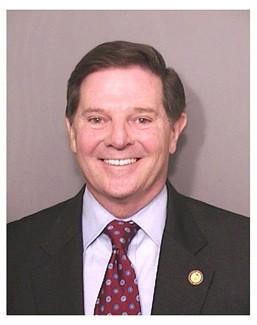
John Kerry Didn't Look this Good with a Face Full of Botox


Democrats hoping to use Tom DeLay's mug shot in their ads and brochures next year have sadly been foiled. Now they can only hope for indictments of Messrs. Rove and/or Libby.

Monday, October 17, 2005

Sorbara’s Plea: Incompetent but Innocent

Recently-resigned Ontario finance minister Greg Sorbara has begun to fight back against RCMP fraud allegations related to his tenure as an independent director and chair of the audit committee of Royal Group Technologies.

In an interview with Richard Brennan of The Toronto Star, Sorbara presented his main line of defence against the allegations that Royal Group shareholders were defrauded when Royal Group purchased property in Brampton from a Sorbara family company. Sorbara tells Brennan that he was concerned “from Day 1” he began serving on the board in 1994 that “we [the board] had no capacity to reverse the decisions of management.” Sorbara says he tried to assert the board’s oversight over management, but he was unsuccessful. For ten years, attending four board meetings a year and an unspecified number of audit committee meetings, he was unsuccessful.

This spin is somewhat at odds with what Sorbara told the Star in March last year, shortly after RCMP, Ontario Securities Commission and Canada Customs investigations into Royal Group became public:

Finance Minister Greg Sorbara says he did not alert a cabinet vetting team that his time as a director at a Woodbridge firm might come back to embarrass the government because he didn’t foresee any problems.

“Absolutely not, because I wasn’t aware of any (problems),” Sorbara told reporters.
--Toronto Star, March 4, 2004
Sorbara did not think McGuinty’s cabinet vetting crew needed to know about his frustrations at Royal before he was given the keys to Ontario’s treasury. Now he is telling the same media outlet that he had concerns about Royal Group management “from Day 1.”

Going back further, to when Sorbara was appointed to cabinet, he told the National Post:

I am quite satisfied with the work I did as a director,” he said. “In the main, the criticism has not been justified, and my duties there were just one of many responsibilities I’ve had over the past few years. I know the board of Royal Group is going through a transformation, in terms of corporate governance, and one of the things I now give up is the opportunity to see that work through.”
--National Post, October 24, 2003

But to Brennan last week he said:

“My energy on the board was to try and force management to try and realize that, as a public company, the responsibilities were dramatically different and that there were shareholders all over the world that had to be accounted to. That was every board meeting and they were ... like four a year. Every board meeting we would push a little, but really unsuccessfully.”

In this latest interview Sorbara admits what some in the financial press had been saying for years: that Royal Group Founder Vic de Zen continued to run Royal Group as his personal fiefdom even after Royal Group became publicly traded and hence partly owned by the working stiffs who contribute to the Canada Pension Plan and Ontario Teachers Pension Plan (N.B. Royal Group's symbol is "RYG". CPP holdings are under "Mutual Fund Ownership" and Teachers’ holdings are under “Institutional Ownership” on the MSN site). When the OSC notified Royal Group of its investigation in December, 2003, the Ontario Public Service Employees Union (OPSEU) Pension Plan held about 750,000 shares, but no longer owns any shares.

Sorbara claims to Brennan that he tried to persuade de Zen to relinquish some power:

“I started to apply pressure at the board, including urging that Vic De Zen either step down as the chair or step down as the president but not hold both positions. I urged him to give up his multiple voting shares. That would have been in probably 2002,” he [Sorbara] said.
Sorbara’s concerns did not seem to be reflected in senior executive compensation for the subsequent year, however:

Shareholders of Royal Group blasted the company’s board this year for approving a pay package for Vic De Zen, chairman and chief executive, that more than doubled to $6.1-million.
The compensation included $500,000 in salary for fiscal 2002, plus a $5.6-million bonus, compared with $2.2-million the year before.

Douglas Dunsmuir, company president, was paid $358,000 in salary and a $3.2-million bonus, also double what he received in 2001.

The company’s share price declined 43% over that time, as sales growth failed to meet internal targets, edging up to $1.9-billion from $1.7-billion.
--National Post, October 24, 2003

Little wonder, then, that Canadian Business magazine named Royal Group’s board the 4th-worst corporate board in August 2003.

As for the sale of two Brampton properties from a Sorbara family company to Royal Group, which transaction was named in the RCMP search warrant executed at The Sorbara Group last week, Sorbara says his brother Ed told him the two companies were talking but Sorbara kept out of it because of the potential for conflict of interest. The article does not delve into whether or not Sorbara, as a Royal insider, understood that the potential conflict should have been disclosed to Royal.

Time will tell what the RCMP and OSC find lacking in Sorbara’s conduct – if anything. In the meantime, Sorbara is girding himself for a battle, Brennan reports, lining up the talents of Julian Porter, one of Canada’s leading libel lawyers, and Frank Marrocco, former Treasurer of the Law Society of Upper Canada (the Treasurer is the top position at the LSUC).

The choice of Porter is interesting. Porter was the lawyer Dalton McGuinty chose to defend him in a libel suit by Tony Clement stemming from McGuinty calling Clement “corrupt” in 1999 around the same time McGuinty was facing his post-election leadership review. Though McGuinty initially pledged to pay his legal fees out of his own pocket, he later quietly had Porter paid by the Legislature’s liability insurers. A lawyer of Porter’s experience and stature likely bills at least $500 an hour. Yet Porter ended up getting much of his Statement of Defence struck out by a judge. About 18 months after the suit was launched, McGuinty finally apologized to Clement – which is what Clement would have settled for in the first place.

The shock of the allegations seems to have caused Sorbara to undergo a bit of a crack-up. On October 11, the night he announced his resignation, Sorbara protested, “I intend to get to the bottom of this. A terrible mistake has been made and I want to know what’s up with it” (Toronto Star, October 12).

On Thursday he said, to a question from the Star’s Richard Brennan, “One of my first emotions this morning was, I just got a sense of the extent of the pain that people who are falsely accused and falsely convicted feel, and it’s not a nice feeling” (scrum, October 13, 2005). Sorbara counts himself with the likes of David Milgard, Donald Marshall and Guy-Paul Morin, who, I believe, actually woke up in prison every morning for a number of years, not in Sorbara’s house in Richmond Hill.

And now we have this interview, in which Sorbara indulges in a bit of Nixonesque paranoia, asking, “Why is this happening? Who is behind this?”

Sorbara offers a clue as to why it is happening: “The fact that I was born with a silver spoon in my mouth is a reality and I think I have become a little bit more of a political target for that basis.” Now where was Sorbara when his party’s first attempt to brand PC leader John Tory – at the leadership vote, no less – was by calling him “Richie Rich”?

The Liberals had eight people toiling in a small room on the sixth floor of the Crowne Plaza Toronto Don Valley. Their strategy was to mock Tory’s blueblood upbringing by distributing silver spoons engraved with “John Tory IV,” vintage Richie Rich comic books and blue loot bags full of other satirical trinkets.
--Toronto Star, September 20, 2004
My late sister had an expression for occasions such as Greg Sorbara pleading, “don’t hate me because I’m rich.” I apologize for the vulgarity but it is apt: “My ass bleeds.”

Sorbara’s minor meltdown is understandable on one level, however. Since his return to public life as Ontario Liberal party president in 1999, he has gone from success to success. He took an impoverished party with a pencil-necked leader that had just been thrashed electorally by one of the most provocative governments in Ontario history. He raised money, found candidates, built the election team and, more than any other individual – including McGuinty – was responsible for its 2003 majority victory.

Through the McGuinty Liberals’ first two years in power, through the 50-plus broken promises and other growing pains, Sorbara never seemed to lose his composure, until the paranoid rantings that began the night of his resignation.

Remember that Sorbara’s last public embarrassment was 13 years ago, when he finished third in the 1992 Liberal leadership race. As an opposition MPP he could retreat into the backbenches unnoticed. Sorbara actually retreated even farther, announcing in 1994 that he would not run again and that he wanted to get involved in his family business:

Liberal sources say the political wounds Sorbara, 47, suffered during the leadership race were slow to heal and that he found himself bored with the marginal role he was given afterward, as critic for urban affairs.

Sorbara said in a statement that he wants to get involved in his family’s extensive business interests.
--Toronto Star, June 18, 1994

But this situation is different. Sorbara was the number two minister in the country’s largest province and there is no hiding. Hence his deer-in-the-headlights look as he walked into a scrum with reporters in a Legislature hallway the day after he resigned.

The Brennan interview and his hiring of two high-powered lawyers suggest that Sorbara is going to mount a pro-active and aggressive defence of his actions, or inactions, as the case may be. And there lies the nub of a problem. For Sorbara to prove that he had nothing to do with this land deal or the other matters for which Royal Group is being investigated requires him to prove that not only was he ignorant of the details of transactions of the family business from which he drew an income (see below), he also failed to assert oversight over a corporation that was handling the pension money of teachers, Ontario public sector workers and CPP contributors. How will that reflect on the McGuinty Liberals during the two-year countdown to the next election?

Friday, October 14, 2005

Greg Sorbara: “successful businessman” or Gary Ewing?

Recently-resigned Ontario finance minister Greg Sorbara is reputedly well liked by Queen’s Park reporters and public servants for his gregariousness and good humour. He has always struck me, however, as one of those people whose arrogance is rooted in a belief that through his superior intellect he can fool enough of the people enough of the time, to coin a phrase. If one starts from that premise, then his string of successes since returning to public life in 1999 would tend to support this picture.

This arrogance would also explain his recent protestations – in the shadow of an RCMP search warrant accusing him of defrauding Royal Group Technologies shareholders in a land deal with The Sorbara Group – that he had no active role in his family’s land development business in the years prior to his return to politics as president of the Ontario Liberal party in 1999. This is what he told the Toronto Star in a story published today:
He told the Star he is a “passive participant” in the company, which his father divided between his children. He said his major income in that time period was from the company but he was doing other things, such as running a baseball franchise in St. Catharines.

Not to be fooled, however, the Star questions Sorbara’s claim:
However, the Sorbara Group’s website says Greg Sorbara has a prominent role in the company. The company states the firm has “an experienced management team combined with the personal hands-on approach of the principals Edward Sorbara, Joseph Sorbara and Gregory Sorbara.” In other forums (such as a Liberal Party of Ontario website) Greg is described as a “principal” of the Sorbara company.
When Sorbara was running in a 2001 by-election necessitated by the sudden death of Vaughan-King-Aurora MPP Al Palladini, here’s how his campaign literature described him to prospective voters:

Sorbara’s experience as a successful businessman, his long-standing commitment to protecting our environment, his proven ability to fight to ensure families get their fair share of funding for health care and public education – all make Greg Sorbara the best candidate to represent Vaughan-King Aurora.
Sorbara’s experience in business has taught him that we must make strategic investments in our future.
So Sorbara now claims that he was just fibbing to voters. He was not in fact a “successful businessman,” but the Gary Ewing of the Sorbara family, whose only business experience was running a minor-league baseball team, and his two generous brothers allowed him to draw a large income from the company in exchange for staying out of their hair.

Thursday, October 13, 2005

Was Endorsing McGuinty a Bad Career Move for Malcolm?


One of Dalton McGuinty's lucky days during the 2003 election was September 19, when he appeared on Michael Landsberg's TSN show "Off the Record" with Ryan Malcolm, a waiter from Kingston who had days before been voted the first Canadian Idol.

Arriving at the studio for the taping, Malcolm was asked by reporters whom he intended to vote for in the October 2 election. "At this point, I'd have to say Dalton McGuinty. I'm a very Liberal kind of guy."

McGuinty was happy to accept the endorsement: "I'm honoured," he said. "I'm here to congratulate him. He's done a great job for Ontario and put the country on the map in a very positive way."

Two years later, McGuinty has been labelled a serial promise breaker, and on the eve of his second Throne Speech lost most of his government's brain power, thanks to the resignation of Greg Sorbara under an ethics cloud. And where is Ryan Malcolm? Rehearsing for the chorus of Ross Petty's latest Christmas kiddie show, a second album deal having thus far failed to materialize.

Tuesday, October 11, 2005

More Deep Thoughts from CBC Staff

Part of me wishes the CBC lockout would last ‘til Christmas, given the barn door it has opened into the attitudes of CBC workers. You cannot make up stuff like this letter from Toronto CBC employee John Corcelli that appeared in Friday’s Toronto Star:

My vision for the CBC begins with a structural change at the top – an elected board of directors. The first board, perhaps with nine people, would be elected by members of the staff and management of the CBC.

Once in place, the board would elect a new president whose term should be no more than three years. The board, with the support of the federal government, Canadians and other interested parties, would draft a new mandate. I would like to see one that is transparent, equal and progressive.
Now, before you get too alarmed that Mr. Corcelli is envisioning a workers’ paradise unaccountable to the suckers who supply it almost $1 billion dollars annually, read on . . .

The mandate would be released to the public [emphasis added] and then the work would begin to create a new CBC. The end of this lockout marks an opportunity for us to do better.
How kind of him to let the public see the CBC’s worker-penned manifesto (workers would comprise the majority of the voters electing the new board) before he sends us the bill. And people say the CBC is indifferent to the general public.

Friday, October 07, 2005

McGuinty Condemns Surplus Allocation Concept he Ran on in 1999

The Toronto Star reports today that Premiers Dalton McGuinty and Jean Charest are peeved that the Martin government is planning to introduce surplus allocation legislation under which “the federal government would divvy up future surpluses by spending one-third of them on reducing the $499 billion debt, one-third on tax relief and one-third on new government spending.”

The Star quotes McGuinty: “I think it’s bad public policy to paint yourself into that corner and to give up any flexibility that you might need in this world where the only constant appears to be change,” the Ontario premier said. “The other reason I’m not supportive of that policy is because it does not address our $23-billion gap in Ontario.”

Yet in his platform for the 1999 provincial election, McGuinty pledged a rather similar surplus allocation formula:

once the budget is balanced, the fiscal dividend would be split three ways:

· 55 per cent for our priorities, primarily health care and education;
· 25 per cent in tax relief aimed at lower and middle-income Ontarians, to help them start to catch up;
· 20 per cent for debt reduction and a rainy day fund, to ensure health care and education are protected in good times and bad.
--20/20 Plan – A Clear Vision for Ontario’s Future, p. 14

As for the $23-billion gap, my empathy for McGuinty is somewhat dimmed by the fact that in opposition, Mike Harris repeatedly asked McGuinty to stand up for Ontario in demanding back the health dollars Paul Martin had cut. McGuinty usually didn’t.

Burn, Hedy, Burn

Andrew Coyne, whose return to blogging is eagerly anticipated by many, has a bang-on column in the National Post today (print edition or subscriber-only on their website) about Svend Robinson’s contemplated return to politics, and other cases of politicians parsing their own ethics, including David Dingwall, PQ contender Andre Boisclair and Dalton McGuinty.

As a Harris Tory, I look back wistfully on his government, under which cabinet ministers actually stepped aside when they were under investigation or committed improprieties. McGuinty promised the same standard, but the cases of Greg Sorbara, Joe Cordiano and Harinder Takhar soon proved him a promise breaker on yet another score.

Returning to Svend: I’m no fan, but if he takes down Hedy Fry I might burn a cross on my own lawn.

Wednesday, October 05, 2005

I knew shelling out would get me back in . . .

I have the privilege of making an appearance on Mark Steyn's not-to-be missed Mark's Mailbox, having finally paid for the daily affirmation provided by his website by buying one of his books.

Monday, October 03, 2005

Public Policy Forum Piles on Harper

The Public Policy Forum, according to its website, “was founded in 1987 to provide a neutral venue where the private sector and the public sector could meet to learn from one another.” Its blurb goes on to say that “the PPF does not sit in judgement of what government does, but looks at how public policy is developed and how the public service is managed.”

Unfortunately, this purported detachment does not apply to what opposition leaders do, hence PPF Vice President (and former Joe Clark chief of staff) Graham Fox’s lengthy indictment of Stephen Harper in today‘s Toronto Star, which appears in Policy Options, a publication of the Institute for Research on Public Policy.

Fox runs through a long and rather stale list of Harper’s failings as leader, as seen through the prism of this spring’s events when the AdScam testimony broke and the Martin government faced confidence votes on its budget. Briefly, these failings are:

· Relying on a small cadre of advisers to the exclusion of all others
· Failing to broaden the base of the new party
· Failing to adapt his strategy to changing circumstances
· Continuing to oppose same-sex marriage, after Canadians have “moved on”
· Blaming others and shutting out different views
· Centralizing party power in the leader’s office

The only original observation I found was Fox’s claim that, according to William Johnson’s recent bio of Harper, Harper is “fundamentally a social conservative.” Is that what Johnson said? I haven’t read the book yet (hoping to get it next week for my birthday), but took a quick look at a library copy and note the following passages:

From a lengthy discussion of Harper’s March 1989 memo to Reform leader Preston Manning, which details much of Harper’s thinking:

While recognizing that the Reform Party should stand for conservative social values, Harper also warned against any departure from moderation, any partiality for “ultra-conservative values” such as nativism and excessive religious fervour. “A modern party of the Right cannot pander either to these minorities or to resentments of them.” (p. 122)

And from page 363:

His (Harper’s) stance for years had been that moral issues should not be a matter of party policy, but each MP should be free to follow his or her conscience and the wishes of the constituents.

Add to these the common knowledge that Harper is a social libertarian and has described himself as such from time to time. So where does Fox derive his conclusion that Harper is a so-con?

The screed ends with the conclusion that Harper “has to decide whether he wants to lead a social conservative movement or a brokerage party. If he opts for the former, he must do so with the clear understanding that he will not form a government . . .” If he wants to lead a “brokerage party”, Harper must “recognize the need for the party to broaden its base and make the kind of policy compromises inherent in that shift.” Since those compromises were basically made at the party’s Montreal policy convention in March, it seems that the only policy compromise Fox is talking about is same-sex marriage.

Same-sex marriage is a challenging issue to deal with, and I would argue that Harper and his MPs have addressed it with more honesty and integrity than Paul Martin has. But what should Harper and conservative MPs say to the vast majority of their supporters who oppose changing the definition of marriage? “Don’t bother us with your deeply-held views on a fundamental social institution! Can’t you see we’re trying to get our hands on the keys to the government limos here?!”

I don’t think that Harper is thrilled about having to continue the debate over same-sex marriage into the next election (where I don’t think it will be a major issue nationally), but should the rise to power consist primarily of jettisoning every issue that may slow or divert one’s progress? Perhaps Fox sees debating contentious policies as a burden. That’s a strange view for someone working for a think tank.

Despite the layers of Saran Wrap supplied by the imprimaturs of the Public Policy Forum and the Institute for Research on Public Policy, Fox’s piece has the smell of a hit ordered by PC malcontents who wanted Harper as leader even less than they wanted merger. Lo and behold, the forum’s staff includes Joe Clark old-timers Jodi White (she’s the President) and Bill Neville (“Senior Advisor to the President” – I am not making this up). Perhaps Fox thinks it is their advice that Harper should have sought on managing minority government situations.

A sidebar: Fox raises the canard of how gay couples that wed pursuant to the various lower court decisions would be “un-married” if new federal legislation were passed. Answer: they wouldn’t. Their situation would be analogous to a house that is built under zoning rules that have been superseded by rules that would not allow the same house to be built today. The existing house does not have to be torn down, as it is a “legal non-conforming use.” As for the married gays, they would eventually die or get divorced.

Friday, September 30, 2005

About Joan Tintor

I am a middle-aged conservative who first became interested in politics when Pierre Trudeau was still the most-despised prime minister in Canadian history, and Brian Mulroney’s interviews were “on background,” not on tape.

My education consists of several years at the University of Toronto (no degree), a Law Clerks’ Certificate from George Brown College, a BAA in Journalism (Magazine) from Ryerson Polytechnic University, and one semester of Cabinetmaking at Humber College (no major injuries). I’ve also taken several continuing ed courses that I can’t be bothered to list in detail.

I have worked as a legal assistant, free-lance writer for Law Times, legislative assistant to Harris-era transportation minister Al Palladini and writer/researcher/librarian for the Ontario PC Caucus.

During the 2007 Ontario election, I blogged on behalf of the PC Party at the "Election Battle Blog" hosted by TV Ontario's "The Agenda."

Global TV using American Footage to Tout its Cultural Diversity

So I was watching the Adam Sandler classic “The Waterboy” the other day on TBS when I noticed that a commercial for an Atlanta Christian radio station featured the exact same clip of hugging, multi-ethnic children that is also in a public service announcement on Global TV, touting Global’s commitment to cultural diversity (sorry, I could not locate an online clip for either commercial).

“How can that be?” I asked myself. Surely Global, a national network with massive production resources at its fingertips would have produced original film with 100% Canadian, ACTRA-card-holding tykes?

Nope. The clip is stock footage from Seattle-Washington based Getty Images, from their “People” category of film CDs. (You have to scroll down to the last two CDs entitled “Lifestyles 2 – Portraits”, click on the “i” to view details, then click on the fourth thumbnail in the top row.)

Ontario political observers may remember that in June 2003 a flap occurred when the McGuinty Liberals revealed that the Eves conservatives had used American stock photo images in a TV ad for their election platform.

A little digging on the Tories’ part soon unearthed that the McGuinty Liberals had used over a dozen American stock photos in their own platform documents, including photos of an MRI machine, a moose, and a guy fishing from a boat with five lines in the water – something that is illegal under Ontario fishing laws. (Full disclosure: I was working for the PC caucus at Queen’s Park at the time and the guys doing the digging were my colleagues.)

Demonstrating the communications skills that have come to serve them so well in explaining their broken promises in office, the Liberals spun back that (1) they had not attributed “voices” to their fake Ontarians as the Tories had in their TV commercial and (2) the guy in the boat represented an American fishing in Northern Ontario. I guess they airbrushed out his assault rifle.

Turning back to Global, if a national network with dozens of cameras, cameramen, and production facilities at its disposal would rather use canned American film than go to the trouble of producing their own footage, there must be good reasons. The ones that I can think of are: convenience, cost, time, not having to find actors/participants, pay them, get releases or pay royalties for each airing.

Someone skilled in this field could probably list a bunch of other reasons. In the case of Global, and in their defence, I might add the CRTC’s policy that “broadcasters accurately reflect the presence of ethnic, cultural and racial minorities and Aboriginal peoples in the communities they service.”

It’s actually kind of fitting that a network called Global is using film of (probably) American kids to remind viewers that it is jumping through whatever flaming hoops of political correctness Canada’s broadcasting poobahs may erect from time as a condition of keeping its license.

The CRTC are the same folks who seem unconcerned that CP24 is ripping off cable subscribers by re-running old CITY-TV newscasts from the 70s and 80s instead of original programming in the dead of night (no offence to the relatives of Colin Vaughan or Bob Hunter). When a 24-hour news channel is allowed to collect basic cable fees plus ad revenue for, say, only 17½ hours of news, it is fair to suggest that Canadian broadcasting regulations operate on the same level of farce as the Canada Health Act, the gun registry and Liberal leadership rules (gosh, I hope I don’t have to add NAFTA to that list). But I digress.

Maybe Global’s use of American stock footage to impress Canadian regulators is some kind of sly inside joke on their CRTC whip holders. I guess there’s no harm in that. But if huge media organizations with in-house production capabilities are resorting to stock images, then perhaps the next time a party is “caught” using them, the media will add some quotes from communications professionals and their own bosses to put the issue in context.

Monday, September 26, 2005

What CBC Employees Think of You

In somewhat the same way that Sherlock Holmes always found the most compelling items to be in the agony columns, I’ve long maintained that the most important sections of any newspaper are the Corrections and Letters to the Editor.

For those of you with any lingering doubt about how your typical CBC employee regards conservatives, check out this excerpt from a missive in Friday’s (September 23) Globe and Mail from locked-out Newsworld employee Natalie Ruskin, responding to Patrick Watson’s bombshell op-ed recommending the CBC be shut down and the entire service put out to tender:

C’mon Watson, who’s the real dinosaur here? For argument’s sake, let’s overlook Patrick Watson’s complete insensitivity toward CBC workers and their jobs when he writes, “Let’s put public broadcasting out to tender,” and “close down the whole institution.” Those remarks are ancient: They existed way before this lockout, their origins from the same dust-covered crop of conventional conservatives who likely struggle to pronounce the phrase “national dialogue.”

Perhaps Ms. Ruskin is too young or has forgotten that the CRTC’s awarding of Canada’s first news channel licence to the CBC was telegraphed and therefore basically fixed in the 1986 Caplan-Sauvageau report on Canadian broadcasting, which recommended an all-news cable channel run by, of course, the CBC. Both this report and the awarding of the news channel to the CBC came to pass under a conservative government. The losing bidder, Western-based Allarcom, appealed the decision to the federal cabinet. A group of Alberta MPs also lobbied cabinet to overturn the decision, but neither was successful. The cabinet did, however, require the CBC to get 20% of Newsworld’s content from private broadcasters and add an all-French news channel.

The Alberta MPs and even some cabinet ministers – including Mulroney, Don Mazankowski and Joe Clark (who was scheduled to appear last week at a rally in support of the CBC) – were reportedly concerned about the additional burden on taxpayers, and awarding a licence to a broadcaster based in central Canada and hostile to the governing party. Wonder why.

This item spurs me to admit that I have been negligent in not checking out the blogs of locked-out CBC workers (lockees?), thinking the occasional glance at Antonia Zerbisias’ column would suffice, but Ms. Ruskin’s shot has prompted me to seek them out.

Anthony Germane? Hardly

In keeping with the above observation about the gems hidden in Letters to the Editor pages, there was an interesting letter in Saturday’s National Post from Anthony Germain, host of CBC Radio’s The House. Germain notes that his fellow lockee, The Hour host George Stroumboulopoulos, is taking a gig at Toronto talk radio station CFRB and concludes thereby that the money Newsworld spent promoting Stroumboulopoulos is improperly benefiting a private-sector competitor:

I’m writing to see if somebody from the National Post can offer CBC managers a training seminar on rational business plans. As an example, consider the case of George Stroumboulopoulos.

CBC-TV has spent hundreds of thousands of (tax) dollars to raise George’s profile for his show The Hour. Now I see that George is also going to host a radio show for Newstalk 1010 on CFRB in Toronto and its sister station, CJAD in Montreal. Standard Broadcasting owns CFRB and CJAD. They directly compete with CBC Radio in the country’s two largest markets. Is not the diffusion of George’s talents a loss for the CBC?

Er, no. I can think of a few things wrong with Germain’s thinking:

(1) George Stroumboulopoulos’ profile stems largely from his years in private broadcasting, not his six months hosting The Hour. Germain says the CBC has spent hundreds of thousands of (tax) dollars to raise Stroumboulopoulos’ profile for The Hour. First of all, Newsworld – where The Hour resides – is funded through cable fees (or at least it’s supposed to be), not the tax dollars that go to the CBC main network and radio. Second, most people know Stroumboulopoulos from his years at private broadcasters Much Music and CITY-TV. So applying Germain’s premise, this private-sector funded profile actually accrued to Newsworld’s benefit when they hired George.

But what’s the core of Germain’s argument? That the CBC should not raise the profile of people who appear in private media and vice versa? Yet every day journalists from the Star, the Globe, CanWest and Sun Media appear on the CBC/Newsworld. I think I’ve even heard some of them on The House.

(2) Standard Broadcasting is not a competitor to the CBC. The notion of competition for listeners in broadcasting is only relevant where advertising is being sold. CBC Radio has no ads and as a publicly funded broadcaster is free of the commercial imperative to seek or maintain a large audience to maximize its revenue. Therefore the CBC does not – and by definition should not – compete with private radio. Germain’s attitude hints at what many believe is a fundamental problem with the CBC: they want to be high in quality but mass in their appeal and influence.

What’s more, CBC and Standard Broadcasting are actually partners in a satellite radio bid recently approved by the CRTC and rubber-stamped by the federal cabinet. Germain should be more concerned with what the CBC’s partnership with private broadcasters in satellite radio might do to his future prospects, not its imaginary competition with private radio. And no, I don’t endorse Standard Broadcasting working with the CBC. Lenin predicted that “the capitalists will sell us the rope with which we will hang them.” Some not-so-bright capitalists seem intent on making that prophecy come true. When they do something as stupid as helping the CBC achieve more reach and revenue, it’s not selling them the rope – it’s giving the rope. And when did the CBC ask their shareholders – or at least our MPs – for permission to expand into private satellite radio? But I digress.

(3) A strike or lockout is not a normal situation. As the public sector unions never fail to remind us when they shut down government services, a strike is “not business as usual” and the public should not expect to be served as if it were. After the lockout, Stroumboulopoulos will presumably be back on the CBC (the CFRB show is only one night a week), making good the bucks the CBC spent to promote him. If he keeps the CFRB show, then his profile on CFRB may enhance his profile at The Hour.

(4) Germain’s anger should be directed at Stroumboulopoulos, not CBC management. By taking another paying job during the lockout, Stroumboulopoulos is “lockout breaking” and betraying his brothers and sisters on the picket line who do not have any employment income.

Not only has Germain missed in his attempt to embarrass CBC managers, he has missed the larger picture. The George Stroumboulopouloses(!) of the world have figured out which way the bus is headed. I hope for Germain’s sake he figures it out too, before it runs over him.

Thursday, September 22, 2005

Oh! Carol (apologies to Neil Sedaka)

Note: the author is a conservative who has never belonged to the Reform party or the Canadian Alliance, and came to support merger only after the PCs were reduced to 12 seats in the 2000 election.

I volunteered to be the interim secretary of the GTA Presidents’ council when Brett Snider founded it last year. When I was asked – repeatedly – to stand for the position of permanent secretary, one of the reasons I declined was the involvement of Carol Jamieson, who in recent years has been slowly destroying her enviable reputation as a political organizer, replacing it with a reputation as a political wing nut. My decision was vindicated when she reportedly appeared at the party’s March policy convention, flogging buttons attacking Stephen Harper. Now she has come out publicly calling for Harper’s resignation.

Carol’s claim that Peter MacKay magnanimously declined to run for leader because he believed the new party needed a new face is laughable: MacKay didn’t run because he knew he couldn’t win, and the same likely applies to whatever contenders Carol is referring to who were scared off by Harper. But if the first rationale is what MacKay wants people to believe, then it is a rationale that creates an obstacle to him running for leader next time, unless he wants to be accused of another Orchard-style flip-flop. His campaign-in-waiting should really be a little more careful about these things.

Carol and the others who promoted Belinda Stronach as a viable prime minister (come on down, Mike Harris and Bill Davis!) bear a good deal of the responsibility for elevating her to a position where she (1) eclipsed the many smarter and better-qualified MPs in our caucus (e.g. Peter Van Loan) and (2) gained the profile to inflict serious short-term damage on the party she herself helped found – damage which she gave little thought to inflicting.

Tony Clement was his usual astute self when he observed that Belinda sucks all the oxygen out of a room. Sadly, little of that oxygen seems to reach her brain stem. I suspect that the main reason Harper hired none of Belinda’s acolytes is because accommodating their pay demands would first require the firing of multitudes. (I wonder whether Carol thinks that now that Harper has fired multitudes, he should still hire Belinda’s people.)

Then Carol undercuts all she has just written, with her view that “the new Conservative Party of Canada had no chance of convincing the Canadian electorate that it was any different than the Canadian Alliance once it picked Stephen Harper as its first leader.” So Carol never supported Harper from the get-go and everything that has happened since has served to confirm that view. So where’s the news here?

I did not support Stephen Harper for leader, but I am frustrated and mystified at why so many in the media and even in our own party are so quick to conclude that he is to blame for the opportunism, venality and incompetence of others. Harper does not strike me as a man who has been plotting and scheming his entire adult life to live at 24 Sussex (unlike the current occupant), but who has reluctantly stepped forward on occasions when he looked around and saw the alternatives were no better qualified or staffed than he. I suspect that the antics of the Carol Jamiesons of the party do little to alter that view.

Wednesday, September 07, 2005

So Sean Penn rents a boat . . .

I was disappointed that in his first monologue since the Katrina disaster, Jay Leno somehow overlooked Sean Penn's pathetic showboating in New Orleans, though he want hard on Bush and FEMA.

Penn's transparent effort to embarrass Bush by showing how easy it is to rescue people (until your own boat starts leaking because you didn't put the drain plug in) were ripe for ridicule. Here are a few gags Leno could have used:


Sean Penn went to New Orleans and hired a boat to try and rescue people, but the boat began to leak and he only had a small cup to bail out the water. The only celebrity bailing himself out faster is Jude Law.

When Sean Penn couldn’t find anyone to rescue, he drove the boat around the city inspecting damage from the storm and subsequent looting. Good news: every copy of the DVD of “Shanghai Surprise” was still on the shelves at Wal-Mart.

Sean Penn went to New Orleans and hired a boat to try and rescue people, but the boat began to leak and almost sank. The next morning a hungover Ted Kennedy turned himself in at police headquarters, accompanied by his lawyer.

Sean Penn went to New Orleans and hired a boat to try and rescue people, but the boat began to leak and almost sank. Sean was able to bail himself out, but he learned a valuable lesson: never rent a used boat from Saddam Hussein.

Friday, July 29, 2005

Step by Step: Tim Murphy on Principles and Ambition

I picked up Steve Paikin's The Dark Side from a remainder table at Indigo and while leafing through it came upon this interesting passage, which was Tim Murphy's reflection on the same-sex benefits imbroglio in 1993/94, when Lyn McLeod was Ontario Liberal leader and Tim was the MPP for St. George-St. David. It is particularly interesting in light of the past few months.


"Every politician comes to the point where they know when they're making the decision to compromise their principles for ambition," Murphy says. "The danger in politics is not that you get to make that decision all at once. You have to make it a thousand times, step by step by step. And the challenge in politics is when you finally get to the one thousandth decision, is there anything left in you? That's the truth of politics. You don't make one big compromise in politics. You make a thousand little ones."
--The Dark Side, p. 253

Murphy insists that the NDP deliberately framed the same-sex benefits issue to trap McLeod (though Rae and Lankin deny it). As reprehensible as Murphy thinks that was, he nonetheless seems to have learned from it.

Thursday, July 21, 2005

Red Ken and Root Causes

The Toronto Star European bureau reports today that London mayor Ken Livingstone “has spent the last two days pinning much of the blame for the July 7 attacks on U.S. and British foreign policy in the Middle East, on the West’s ‘double standards’ in the Israeli-Palestinian conflict, and on CIA-trained Osama bin Laden turning on his ‘creators.’”

Says Red Ken: “You’ve just had 80 years of Western intervention into predominantly Arab lands because of the Western need for oil. We’ve propped up unsavoury governments, we’ve overthrown ones we didn’t consider sympathetic,” he told BBC Radio’s Today program yesterday. And I think the particular problem we have at the moment is that in the 1980s, the Americans recruited and trained Osama bin Laden, taught him how to kill, to make bombs, and set him off to kill the Russians and throw them out of Afghanistan.”

Well, Ken didn’t manage to get these helpful thoughts out of his mouth nearly as quickly as Muslim groups were to pronounce themselves victims of racist “retaliation” that has yet to occur, but I guess less than a fortnight is fast enough, and mighty fast for an old socialist.

At times such as these it is helpful to remember that terrorism is, to choose arbitrary figures, 5% physical and 95% psychological. The psychological aspect of terrorism is not confined to grief over dead innocents or fear of going about one’s daily lives. It extends to the self-doubt and self-flagellation that occur when rational societies return again and again to the question “what did we do to deserve this?”

As much as Islamic terrorists hate Western culture, they understand and exploit it well. They understand that for the modern Western politician, inaction and deferred decision-making are the paths of least resistance; decision and action are swiftly met with criticism; too many decisions and actions tempt electoral defeat. The terrorists also understand that even decisions which are long past or irreversible are open to criticism and revisionism. Most in the West consider this openness to re-examination to be a strength -- those who would destroy Western culture consider it a weakness that works to their advantage, as it leaves their victims in a permanent state of second-guessing past actions, and fear and confusion over future ones. But second-guessing is not in the vocabulary of the terrorists. They do not publicly debate whether killing Muslims is consistent with their professed beliefs and values. They do not regard their bombings of Western civilians as inappropriate meddling in our affairs.

This is not to say that there is anything to fear in re-examining and re-affirming the West’s insistence that Israel be allowed to exist in peace and security; that it was worthwhile to forestall Soviet expansion into the Middle East through Afghanistan; and that, whether or not one of the reasons for invading Iraq was mistaken, Iraq and the Middle East are better off without Saddam Hussein, and America and its allies must remain until Iraq is stable.

I wish, however, that those of Ken Livingstone’s ilk would occasionally add to their list these items: whether it was prudent for the U.S. to reward terrorism by pulling out of Lebanon after the Marine barracks bombing in 1982, to trade arms for hostages in the 1980s, or to treat the major al-Qaeda attacks in the 1990s as criminal matters, not acts of terrorism and warfare. It would also be useful to remember that the West took the side of Muslims in Kuwait, Bosnia and Kosovo in the 1990s, and used force to do so, yet Bosnia and Kosovo were and continue to be recruitment and training centres for Islamic terrorists. If Livingstone were to look at all that has happened since the Islamic Revolution in Iran in 1979, he would see that the terrorists change their spin as frequently and ingeniously as they change their methods, and that Western help for Muslims abroad and weakness on terrorism have hardly diminished the terrorists’ fervour.

Part of fighting terrorism is distinguishing between reasonable reflection on past actions and policies, and the wholesale rejection of past policies and actions, based solely on terrorists’ less-than-trustworthy claims that these are the reasons for their horrific acts. My own suspicion is that if the West is doing things that terrorists say they are angry about, then we are on the right track, not the wrong one.

Friday, June 17, 2005

Chaoulli: Supremes Play Daddy -- Again

My understanding of the Supreme Court’s decision is this: the court did not say that private health care is superior to public care. The court did not open the door to private health care. The court did not signal the end of Medicare, or “Tommy Douglas’ Dream”, or whatever jacked-up phrase the health care unions are using these days.

All the court said is that if the government enforces one, single-payer system of health care, if that system covers most medically-necessary services (as the tenet of “comprehensiveness” in the Canada Health Act dictates it must) and if citizens are barred from purchasing those services elsewhere in Canada through private insurance or direct payment, then that health care system cannot be a farce. Specifically, it cannot be a farce that allows a good number of people to go undiagnosed, die on waiting lists or live for years in pain and/or disability waiting for surgery or treatment.

This decision, however, is wrong.

It is no mystery to many Canadians that the health care system became a farce long ago. Those who were somehow unaware of this fact could easily inform themselves of it through regular perusal of the major media. Yet at almost every opportunity that Canadians have had to say that the emperor has no clothes – or the patient has no gown, or bed, or MRI – they have voted to continue the farce.

When the Ontario Liberal government moved to ban so-called extra billing in 1986 (i.e. modest user fees set by individual doctors, but not universally imposed), the public cheered, and a Toronto Star editorial cartoon famously portrayed doctors as pigs. The Liberals won a massive majority the following year.

When Paul Martin cut the health and social transfer to the provinces by $25 billion in the mid-90s, he was portrayed as a good fiscal manager. Provincial governments trying to restructure their hospitals and keep up with rising costs and demands were portrayed as villains. Occasionally the Liberals would use the Canada Health Act to threaten provinces who dared even hint at expanding private delivery to improve services (unless that province went by the name “Quebec”).

In the 2000 and 2004 federal elections, the merest whiff of “two-tier” health care, or allowing more private delivery, or even allowing provinces to experiment within the public system, drew high-pitched attacks from the Liberals. Liberal re-election soon followed.

In the 2003 Ontario election, one of Dalton McGuinty’s promises – and one of the few he kept – was to use provincial dollars to buy out nine privately-operated MRI clinics that were providing tests under OHIP, as do hundreds of other private facilities and labs that somehow escaped McGuinty’s notice.

So events suggest that Canadians have quite deliberately chosen this state of affairs. They have chosen anodyne rhetoric over difficult reform. They have chosen 1960s mythology over 21st century reality. They have chosen to risk delayed diagnosis, chronic pain and even death because they accept that all the other options are worse, and one step away from bankruptcy through illness or dying in the street, which happens every day in the United States, don't ya know?

Whether this choice was made consciously or unconsciously is no matter. Voters are adults and should be treated as such. They should bear the consequences of their actions, and not be soothed with the lie that those consequences are not their fault, and it’s someone else’s responsibility to fix things. In short, we have a farcical, Soviet-style health care system that Canadians have affirmed and re-affirmed again and again. Who is the Supreme Court to override their votes? Who is the Supreme Court to save them from themselves?

Yet this is precisely what the Supreme Court, in its well-intentioned way (for they are always well-intentioned when they declare that democracy got it wrong) has done. Is it a mature populace that requires four lawyers in St. Nicholas robes to force them to look at the truths they were vaguely aware of but chose not to see?

Conservatives who have argued for honest language and mature debate on health care have nothing to celebrate in this ruling, even if they do agree with its gist. And it is no less a case of judicial activism than the same sex marriage rulings. “The end justifies the means” is a rationale typical of the other end of the political spectrum.

As for the honest, realistic debate that many hope will be spurred by this ruling, I’m not holding my breath. The Supreme Court is unlikely to wipe away the health care delusions of Canadians, when a decade of declining services and increasing waiting lists have done nothing but reinforce those delusions.

Some may argue that this decision was a blow on behalf of the people against institutions that believe they know what’s best for Canadians, whether those institutions be bureaucracies, legislatures or courts. Sadly, it is just the opposite.

Wednesday, June 08, 2005

Reflections on the Revolution

It was 10 years ago today that the Ontario electorate closed the door on 10 years of Liberal/NDP gluttony and government expansion, and took a chance on an 11-toed golf pro from North Bay wielding a driver in one hand and a Common Sense Revolution booklet in the other.

I was lucky enough to be working at PC campaign headquarters, and the day after the election volunteered to help out on the switchboard, which was surprisingly busy. Most of the calls were from regular folks calling to say congratulations or remind us to do what we promised. At one point a scruffy young fellow dashed into the reception area, snatched a small stack of CSRs from a desk, and rushed back onto the elevator before Tony Quirk or I could inquire as to where he got those wicked tattoos, or could he spare a spliff?

I thought nothing of the incident until I saw the same dirtbag and his comrades on the TV news that night, setting fire to their liberated platforms. Many people scoffed at Mike Harris when he talked about the “vested interests” who opposed change. Whenever they did, I would think back to our rude visitors who unwittingly set the tone for the years to come by setting fire to the CSR, doubtless without reading it, and before the government was even sworn in.

Anyhow, the intransigence of the vested interests was demonstrated soon enough. On many issues the revolutionaries prevailed, but I found it remarkable that on Mike Harris’ retirement, he observed that he wished he had moved more quickly on more fronts when he was first elected. I hope our next conservative premier will keep that in mind, because as we soon found out, the vested interests are focussed on government 24/7, while taxpayers are lucky to find an hour a week to be informed or engaged.

Margaret Thatcher once said that the test of her record would not be its effect on the conservative party, but its effect on their opponents. In that respect, the CSR has had some success: though presenting themselves as the antithesis of the Harris regime, the McGuinty Liberals had to present a clear platform and appear to be fiscally responsible – including a promise not to raise personal taxes – in both the 1999 and 2003 elections. Several times as opposition leader, McGuinty called the balanced budget and taxpayer protection laws “the price of admission” for any party seeking government, and even attempted to rewrite history by boasting that the Liberals had supported the concept in 1995 – which they had not (only four Liberal candidates signed the Canadian Taxpayers’ Federation pledge in 1995).

Though in office the McGuinty fiscal plan and no-tax-hike promise quickly collapsed, on other issues the Fiberals have quietly affirmed the wisdom of several Harris-era policies, such as per pupil funding and health care restructuring. Yet while the concept of respecting the taxpayer and his dollars has become entrenched among mainstream parties – even the NDP – Mike Harris’ dictum that “there is only one taxpayer” seems to have lost some currency lately. Witness our dear premier’s discovery of a “gap” between taxes paid by Ontarians to the federal government, and the largesse doled out directly from the federal government to the provincial government. This is now blowing back on Dalton, as David Miller has discovered a parallel “gap” vis a vis Toronto taxpayers and the provincial government. Enjoy the whirlwind you have reaped, Dalton!

As unbelievable as it may seem, after all this time there is at least one test remaining for the revolution: is keeping promises still important to voters? Will voters punish the Fiberals for their many broken promises, or be anaesthetized by the quiet in the schools? As Kent Brockman would say: only TIME will tell.

No matter what happens, those of us who had a seat at the revolution can say that we made many long-overdue changes for the better, and “did what we said we would do.”

Vive la revolucion.