In the dying days of the kerfuffle over whether or not the dog barked, so to speak, comes a helpful reminder from the Ontario Liberal Party about their convention in Toronto this weekend, which will no doubt be abuzz with federal leadership politicking. The official star attraction, however, is American political consultant, author and bomb maker (e.g. exec producing “All the King’s Men”) James Carville.
Carville once said of Paula Jones – who sued Bill Clinton for sexual harassment she alleged occurred when Clinton was Arkansas governor – that “If you drag a hundred dollar bill through a trailer park, you never know what you'll find.” Now I guess there is no objective measure of these things, but that strikes me as a tad harsher than being compared to a dog.
It was Clinton’s shading of the truth in his deposition given in the Paula Jones lawsuit that led to the Lewinsky revelations and his eventual impeachment, which he survived. Jones ultimately collected $850,000 from Clinton in settlement of her sexual harassment lawsuit. That’s about half the $1.6 million “All the King’s Men” made in its second week of release, having earned $3.7 and finishing number 7 in its opening week.
Friday, October 27, 2006


Monday, October 23, 2006
Liberals, timing and fair play
Liberals are howling* that the Prime Minister has called two by-elections to be held on the eve of the Liberals’ leadership convention.
For the record, and as a handy reminder, here are a few examples of the Liberals’ sensitive timing when it came to general elections. Not by-elections – general elections.
April, 1997: Jean Chrétien drops writ for June general election on April 27th – Orthodox Easter Sunday.
October, 2000: Jean Chrétien drops writ for November general election – four months after Stockwell Day was elected leader of the Canadian Alliance (yes, Day dared Chrétien to drop the writ, but that's not why they did it).
May, 2004: Paul Martin drops writ for June general election – two months after Stephen Harper was elected leader of the new Conservative Party (Team Martin was actually hoping to do it even earlier, but pesky sponsorship revelations kept forcing them to push the date back).
It's called the Golden Rule, boys and girls. Sucks, doesn’t it? So suck it. Hard.
Kitchener Conservative has also posted on this topic.
*Liberal party president Mike Eizinga calls it "a conniving, tactical play." Isn't Eizinga the guy for whom Team Martin booted Akash Maharaj out of the way for the party presidency? Well, I guess he would know from conniving.
For the record, and as a handy reminder, here are a few examples of the Liberals’ sensitive timing when it came to general elections. Not by-elections – general elections.
April, 1997: Jean Chrétien drops writ for June general election on April 27th – Orthodox Easter Sunday.
October, 2000: Jean Chrétien drops writ for November general election – four months after Stockwell Day was elected leader of the Canadian Alliance (yes, Day dared Chrétien to drop the writ, but that's not why they did it).
May, 2004: Paul Martin drops writ for June general election – two months after Stephen Harper was elected leader of the new Conservative Party (Team Martin was actually hoping to do it even earlier, but pesky sponsorship revelations kept forcing them to push the date back).
It's called the Golden Rule, boys and girls. Sucks, doesn’t it? So suck it. Hard.
Kitchener Conservative has also posted on this topic.
*Liberal party president Mike Eizinga calls it "a conniving, tactical play." Isn't Eizinga the guy for whom Team Martin booted Akash Maharaj out of the way for the party presidency? Well, I guess he would know from conniving.
Friday, October 13, 2006
What I might have written about the Pope’s Regensburg speech (if I were smart enough)
I recommend this column by Father Raymond J. De Souza in the September 29th edition of Maclean’s. Some excerpts:
When the controversy first broke, I read the Pope’s speech several times. I was tampted to post about it but hesitated, given my lack of knowledge about the issues the Pope addressed. In the interim, I have come across several columnists who shared some of the same impressions I drew from the speech: that violence is incompatible with faith, that faith without reason is dangerous, and that it is not immediately apparent why the Pope mentions Islam at all in a speech that is largely about the reconciliation of faith and reason within Christianity.
As for the Pope quoting the 600-year-old observation of a Byzantine (i.e. Orthodox, not Catholic) emperor about Mohammad’s “command to spread by the sword the faith he preached,” at the time of the speech I happened to be reading John Keegan’s A History of Warfare, which includes the following:
Footnote: The Associated Press reported yesterday today that jihadists have beheaded an Orthodox priest in Iraq.
The main point of the Regensburg address was that faith and reason need each other as paths to truth. Benedict defended this as an essential part of Christian belief because the God who reveals himself (faith) is also the author of the natural order and the human capacity to understand it (reason). The Pope highlighted that the prologue of John's Gospel begins, "In the beginning was the word (logos)," and logos is the Greek word for reason. God is reasonable, and so to act contrary to reason is to act contrary to God.
Faith without reason gives rises to fundamentalism. Reason without faith produces a secularism that cannot address the most fundamental of human questions about origin, destiny and meaning. The bulk of Benedict's address was directed against the latter phenomenon, criticizing a modern secularism that has nothing to say to people of faith, and nothing to say about the foundations of human culture. In criticizing the neglect of reason in favour of faith alone, Benedict criticized a major figure in the history of Christian philosophy (John Duns Scotus), who he considered to have made this mistake.
So why, if that was Benedict's main point, get into Islam at all? Why the incendiary quotation from Byzantine Emperor Manuel II Palaeologus on the evil of Islam, spreading faith by the sword?
One of the potential consequences of a faith-only fundamentalism is violence. Violent force -- which by its nature does not seek to persuade -- can grow out of a zeal to convert without recourse to reason. It is simply a fact that Islamic violence is a growing problem around the world. Muslims themselves are the first victims of it, but Christians in Islamic countries regularly face harassment and persecution. Benedict wants to clarify that the roots of this violence lie in a perversion of Islam, not its authentic theology. That's a task only Muslims can accomplish, but the Pope has a pulpit sufficient to draw attention to the issue.
When the controversy first broke, I read the Pope’s speech several times. I was tampted to post about it but hesitated, given my lack of knowledge about the issues the Pope addressed. In the interim, I have come across several columnists who shared some of the same impressions I drew from the speech: that violence is incompatible with faith, that faith without reason is dangerous, and that it is not immediately apparent why the Pope mentions Islam at all in a speech that is largely about the reconciliation of faith and reason within Christianity.
As for the Pope quoting the 600-year-old observation of a Byzantine (i.e. Orthodox, not Catholic) emperor about Mohammad’s “command to spread by the sword the faith he preached,” at the time of the speech I happened to be reading John Keegan’s A History of Warfare, which includes the following:
Christians, indeed, have never found unanimity in the belief that the man of war may also be a man of religion; the ideal of martyrdom has always been as strong as that of the justified struggle and remains strong to this day. The Arabs of the conquest years were not caught on that crux. Their new religion, Islam, was a creed of conflict, that taught the necessity of submission to its revealed teachings and the right of its believers to take arms against those who opposed them. It was Islam that inspired the Arab conquests, the ideas of Islam that made the Arabs a military people and the example of its founder, Muhammad, that taught them to become warriors.
Muhammad was not only a warrior himself, who had been wounded in a battle at Medina against the men of Mecca in 625. He preached as well as practiced war. In his last visit to Mecca in 632 he laid down that, though all Muslims were brethren and should not fight each other, they should fight all other men until they said ‘There is no god but God.’ The Koran, which Muslims believe to have been taken down from his words by disciples, elaborates this command extensively. Even more specifically than Christ had done, Muhammad insisted that those who accepted the word of God thereby formed a community (umma) whose members owed each other responsibilities; thus it was not enough simply to avoid fratricide: Muslims were under an obligation to do positive good to less fortunate Muslims by assigning a certain portion of their income to charity; they also had a duty to care for each other’s consciences. Beyond the umma, however, the obligation was reversed: ‘O you who believe, fight the unbelievers who are near to you.’ This was not a call to forcible conversion. Non-believers who were prepared to live under Koranic authority were positively entitled to protection and, in strict theory, those outside the umma who kept the peace ought not to be attacked. In practice, however, the bounds of the umma came to coincide with the House of Submission (Dar al-Islam), while outside inevitably lay the House of War (Dar-el-Harb). Against the House of War, Islam fell into conflict from the moment of the prophet Muhammad’s death in 632.
Another factor greatly assisted the Arabs who, in the last years of Muhammad’s life, set out to extend the boundaries of Islam: the kingdoms on which their force fell were in decline. . . .
When, therefore, in 633 an Arab army invaded northern Mesopotamia, the Persian army was not what it had been; neither was the Byzantine. Audaciously, the Arabs chose to operate against both simultaneously and, though compelled to transfer forces between the two fronts, they succeeded in holding their own; in 637 at Qadisiyah, near modern Baghdad, they won a victory that ensured the triumph of Islam in Persia; the significance of that victory remains so great in the Arab world that in the 1980s it was constantly evoked by Saddam Hussein during his war of attrition with Iran. Meanwhile other Arab armies were conquering Syria (636), Egypt (642) and pressing westward along the Mediterranean coast toward the Byzantine provinces in North Africa. In 674 Mu’awiya, the fifth caliph or ‘successor’ to Muhammad, decided to lay siege directly to Constantinople, and though the Arabs gave up the effort in 677, they returned in 717. By that year, they had taken the whole of North Africa (705), crossed to Spain (711) and reached the Pyrenees, over which they shortly invaded France. In the east they conquered Afghanistan, raided into north-west India, annexed part of Anatolia (modern Turkey), pushed their northernmost boundary to the line of the Caucasus mountains and crossed the Oxus into Transoxiana where, at the Talas River in 751, they fought a decisive battle with the Chinese for dominance over the great cities of Bokhara and Samarkand, on the Silk Road which led to the Great Wall.
--from A History of Warfare, pp. 193-195
Footnote: The Associated Press reported yesterday today that jihadists have beheaded an Orthodox priest in Iraq.
Monday, October 02, 2006
Peter Naglik, 1967-2006
I worked with Peter Naglik between 1997 and 2001 at Queen’s Park in what was then called Government Members’ Services, in the research and communications shop.
Though our team included people who had worked in the Premier’s Office, in ministers’ offices, and the former top civil servant in an Atlantic province, we suspected that we were looked upon with a mixture of pity and derision by many of our colleagues who got paid by the Government of Ontario, and not by the Legislative Assembly.
Fools.
In opposition, caucus service bureaus face huge demands and are relied upon heavily by leaders and members. But in government -- free of the inertia of the bureaucracy, and largely ignored by the media -- they are able to devote much of their resources to pure, unadulterated politics, i.e. F-U-N. Opposition research. Attack releases. Recording, transcribing and regurgitating the careless bluster of hapless critics and MPPs.
Prudence and modesty preclude me from detailing our exploits more fully. Suffice to say our boss liked to inspire us with this quote from “Conan the Barbarian:”
Mongol General: Conan, what is best in life?
Conan: To crush your enemies, see them driven before you, and to hear the lamentation of the women!
With Conan’s bloodlust as our credo, we hardly missed the turgid briefing notes, endless meetings, Question Period, or angry calls from the Premier’s Office (though they knew they could count on us when needed) – the quicksand that pushed at both ends of every government staffer’s day. Why would we?
One of Peter’s moments of glory came during the 1999 general election, when he was doing media monitoring late one night. He spotted a new Liberal ad, one featuring a clip of the Premier describing himself as “mean, mad Mike Harris.” Peter thought he recognized it from an old Focus Ontario broadcast. By morning, the tape had been located, reviewed and our war room was all over the fact that the Liberals had taken Harris’s quote wildly out of context. Harris had in fact been hypothesizing about what his reaction would be if the federal Liberals were to waste the money they cut from transfer payments to the provinces on a new program, instead of balancing the budget. (As history and Gomery have recorded, they ended up doing both.)
There are few bigger coups during an election than having your opponent’s paid media blow up in his face. Peter could have bragged about having bagged that rarest of election game, but didn’t. The thrill of nailing the Liberals was reward enough.
Peter not only had a sharp eye, and an even sharper pen, but a gift for the invented word and pointed phrase. Caribbana was, in his view, “Scary-bana.” He referred to gay conservatives – some of whom were genuine friends – as “homo-cons.” The PC-DRC alliance was the “Tory Dorks.” Commenting on the personal hygiene of a certain member of the Queen’s Park Press Gallery, he remarked that said reporter always looked like a “glazed donut.” He occasionally referred to one of our MPPs, Carl De Faria, as “Count Chocula.” There was no malice in any of this – it was merely Peter’s mischievous yet accurate shorthand.
Peter was an exacting writer, but it amused him to see others hammer perfectly innocent words into ungainly shapes to fit their political ends. He particularly enjoyed the way the word “community” was seized upon by any group grasping for political, societal or professional legitimacy, such as the “actuarial community” – a real example. He would have been tickled that the Ottawa Citizen report of his death included not one, but two quotes featuring the phrase “political community.”
Peter’s and my time at GMS was concurrent with a turbulent yet seemingly hopeless era in federal politics. How far away now seem the passions that surrounded Reform’s reinvention as the Canadian Alliance, the leadership of Stockwell Day, and the futile attempts to merge with the broke-but-proud PCs. Peter had respect for many of us PCs, even the ones who opposed merger – though he did try to rile me with offhand remarks about how the PC party was really being run by David Orchard.
Working on the CA’s 2000 election campaign left him slightly bruised, but unbowed. When he went to work in the leader’s office for Day in 2001, I told him I thought what he was doing was honourable, though the truth unacknowledged between us was that it was probably a lost cause. Day, already wounded by his own mistakes, was besieged by a cabal that had never accepted his wresting of the leadership from Preston Manning.
But Peter went anyway. For all of his respect for strategy and tactics, focus and discipline, Peter still believed that substance matters. That politics is about more than being with the winner, or a $25,000 cheque for two months’ work on a leadership campaign. Sometimes it’s about helping a friend who’s in a tougher race than he expected. Sometimes it’s helping someone track down a report or quote they can’t remember the title or date of. To turn Vince Lombardi on his head: in politics, winning may be everything, but to Peter it wasn’t the only thing.
When I took Peter for a farewell lunch at the Hart House Gallery Club, then councillor Tom Jakobek and former councillor Dennis Fotinos recognized him and greeted him warmly. That was typical of the “Naglik knows” myth that was 5 per cent myth and 95 per cent reality. Once he participated in a “dead pool” at Queen’s Park and predicted that then Globe and Mail editor William Thorsell would meet his maker sometime in the following year. A Queen’s Park columnist immediately e-mailed Peter, demanding “What do you know?” Nothing, as it turned out. But Peter relished having set the cat among the pigeons.
Peter had a strong faith, which I envied desperately. He respected most religions, but scoffed at those that seemed determined to sand down all their surfaces until only a toothpick remained. When we attended a Canadian Club luncheon, he expressed sarcastic astonishment that the United Church minister who said grace actually uttered the word “Jesus.”
I have no doubt that Peter’s faith was the soil from which his general cheer and equanimity grew. Once during a conversation we were having about the state of the world, he said that he believed we were living in the “end times” (I wasn’t always sure when he was pulling my leg). I responded with something forgettable – which I have forgotten – to which he chuckled, threw up his hands and replied, “I gotta go sometime.”
That his sometime has come now, has broken my heart in a way that I thought it could never be broken again. But I will not begrudge him the break. He deserves that and more.
Rest in peace, unique one. Or as you would say, “Bye for now.”
Though our team included people who had worked in the Premier’s Office, in ministers’ offices, and the former top civil servant in an Atlantic province, we suspected that we were looked upon with a mixture of pity and derision by many of our colleagues who got paid by the Government of Ontario, and not by the Legislative Assembly.
Fools.
In opposition, caucus service bureaus face huge demands and are relied upon heavily by leaders and members. But in government -- free of the inertia of the bureaucracy, and largely ignored by the media -- they are able to devote much of their resources to pure, unadulterated politics, i.e. F-U-N. Opposition research. Attack releases. Recording, transcribing and regurgitating the careless bluster of hapless critics and MPPs.
Prudence and modesty preclude me from detailing our exploits more fully. Suffice to say our boss liked to inspire us with this quote from “Conan the Barbarian:”
Mongol General: Conan, what is best in life?
Conan: To crush your enemies, see them driven before you, and to hear the lamentation of the women!
With Conan’s bloodlust as our credo, we hardly missed the turgid briefing notes, endless meetings, Question Period, or angry calls from the Premier’s Office (though they knew they could count on us when needed) – the quicksand that pushed at both ends of every government staffer’s day. Why would we?
One of Peter’s moments of glory came during the 1999 general election, when he was doing media monitoring late one night. He spotted a new Liberal ad, one featuring a clip of the Premier describing himself as “mean, mad Mike Harris.” Peter thought he recognized it from an old Focus Ontario broadcast. By morning, the tape had been located, reviewed and our war room was all over the fact that the Liberals had taken Harris’s quote wildly out of context. Harris had in fact been hypothesizing about what his reaction would be if the federal Liberals were to waste the money they cut from transfer payments to the provinces on a new program, instead of balancing the budget. (As history and Gomery have recorded, they ended up doing both.)
There are few bigger coups during an election than having your opponent’s paid media blow up in his face. Peter could have bragged about having bagged that rarest of election game, but didn’t. The thrill of nailing the Liberals was reward enough.
Peter not only had a sharp eye, and an even sharper pen, but a gift for the invented word and pointed phrase. Caribbana was, in his view, “Scary-bana.” He referred to gay conservatives – some of whom were genuine friends – as “homo-cons.” The PC-DRC alliance was the “Tory Dorks.” Commenting on the personal hygiene of a certain member of the Queen’s Park Press Gallery, he remarked that said reporter always looked like a “glazed donut.” He occasionally referred to one of our MPPs, Carl De Faria, as “Count Chocula.” There was no malice in any of this – it was merely Peter’s mischievous yet accurate shorthand.
Peter was an exacting writer, but it amused him to see others hammer perfectly innocent words into ungainly shapes to fit their political ends. He particularly enjoyed the way the word “community” was seized upon by any group grasping for political, societal or professional legitimacy, such as the “actuarial community” – a real example. He would have been tickled that the Ottawa Citizen report of his death included not one, but two quotes featuring the phrase “political community.”
Peter’s and my time at GMS was concurrent with a turbulent yet seemingly hopeless era in federal politics. How far away now seem the passions that surrounded Reform’s reinvention as the Canadian Alliance, the leadership of Stockwell Day, and the futile attempts to merge with the broke-but-proud PCs. Peter had respect for many of us PCs, even the ones who opposed merger – though he did try to rile me with offhand remarks about how the PC party was really being run by David Orchard.
Working on the CA’s 2000 election campaign left him slightly bruised, but unbowed. When he went to work in the leader’s office for Day in 2001, I told him I thought what he was doing was honourable, though the truth unacknowledged between us was that it was probably a lost cause. Day, already wounded by his own mistakes, was besieged by a cabal that had never accepted his wresting of the leadership from Preston Manning.
But Peter went anyway. For all of his respect for strategy and tactics, focus and discipline, Peter still believed that substance matters. That politics is about more than being with the winner, or a $25,000 cheque for two months’ work on a leadership campaign. Sometimes it’s about helping a friend who’s in a tougher race than he expected. Sometimes it’s helping someone track down a report or quote they can’t remember the title or date of. To turn Vince Lombardi on his head: in politics, winning may be everything, but to Peter it wasn’t the only thing.
When I took Peter for a farewell lunch at the Hart House Gallery Club, then councillor Tom Jakobek and former councillor Dennis Fotinos recognized him and greeted him warmly. That was typical of the “Naglik knows” myth that was 5 per cent myth and 95 per cent reality. Once he participated in a “dead pool” at Queen’s Park and predicted that then Globe and Mail editor William Thorsell would meet his maker sometime in the following year. A Queen’s Park columnist immediately e-mailed Peter, demanding “What do you know?” Nothing, as it turned out. But Peter relished having set the cat among the pigeons.
Peter had a strong faith, which I envied desperately. He respected most religions, but scoffed at those that seemed determined to sand down all their surfaces until only a toothpick remained. When we attended a Canadian Club luncheon, he expressed sarcastic astonishment that the United Church minister who said grace actually uttered the word “Jesus.”
I have no doubt that Peter’s faith was the soil from which his general cheer and equanimity grew. Once during a conversation we were having about the state of the world, he said that he believed we were living in the “end times” (I wasn’t always sure when he was pulling my leg). I responded with something forgettable – which I have forgotten – to which he chuckled, threw up his hands and replied, “I gotta go sometime.”
That his sometime has come now, has broken my heart in a way that I thought it could never be broken again. But I will not begrudge him the break. He deserves that and more.
Rest in peace, unique one. Or as you would say, “Bye for now.”
Wednesday, September 27, 2006
Never mind the wife and kids, I’M the victim here
Well, Belinda Stronach is in the news again and, yet again, she is the victim of dastardly forces determined to deny Canadians the benefit of her goodness and leadership.
Stronach has decided that what is important in the Domi divorce is not the break-up of a marriage nor its three children, but that yet again she is the victim of a political culture that is biased against women in general and her in particular. From today’s Globe and Mail:
As implied above, it wouldn’t be the first time Stronach demonstrated a narcissism to rival Bill Clinton’s (no wonder they’re simpatico).
She cut and run from the Conservative party, because she had irreconcilable political differences with Stephen Harper – not because she wasn’t getting enough attention or being promoted enough. Yet she has seen Harper close up in her role in brokering the merger of the Progressive Conservative and Canadian Alliance parties in 2003, and from the leadership race in 2004.
She couldn’t run for Liberal leader, because the party wasn’t going to allow a pure one-member, one-vote process – not because she was politically radioactive and new election laws prevented her from financing a lavish campaign out of her own pocket like she did in 2004. Yet in the Conservative leadership race she argued in favour of the riding-weighted one member, one vote process, likely because it would have given her an edge in Québec.
Now she is alleged to have been the trigger that ended a 13-year marriage that has produced three children. (As they have been neither admitted nor proven, I am not going to assume that the allegations are true.)
Here’s one option she could have taken: through a spokesperson, express concern for the family and decline further comment. Here’s what she did: gave a TV interview in which she refused to confirm or deny the alleged affair, instead focussing on her own suffering and attempting to hitch it to the larger issue of the travails of public life.
Of course, Stronach would or should have known that the interview was destined to spawn another round of stories about the divorce allegations. Yes, it is fair to say that Mrs. Domi must shoulder most of the blame for drawing attention to the situation, with the explosive and detailed allegations set out in her divorce papers. But Stronach, had she paused to reflect, should know better. She’s been a public figure for years, has two children, and has been through two divorces herself. Leanne Domi and her three kids haven’t.
It may also be that Stronach’s concern for women in public life is yet another injection-moulded spin from the Magna assembly line. Despite her lamentations on CTV, and current position as head of the Liberal women’s caucus, Stronach’s sister act may be more talk than walk, if Leanne Domi’s divorce papers are to be believed:
But, in Stronach’s defence, why would she pay attention to the “wives of?” In the eyes of someone who has never grasped the concept of a team, wives are just another amorphous group of lower life forms – like a caucus. When you are a star, ignoring lower-status women is not necessarily sexism, just good time management.
As I noted recently, Stronach is the only person in the world who fails to grasp that, were she not a wealthy, attractive, woman, she would have no public life which to lament. And, her hypothesis that men would not be subjected to similar attention in similar circumstances is unconvincing, as the case of the late Ontario cabinet minister Al Palladini suggests.
In 1995, Palladini was the target of a claim for child support from a former girlfriend. At the time of the suit and during their relationship, Palladini was married. The details, allegations, and headlines were ugly and painful to everyone involved. (I was working for him at the time.)
He did not enjoy the experience, and I’m pretty sure there were some reporters he wanted to deck, but he never once publicly whined about his situation, nor blamed the furor on his Italian heritage (hello, Joe Volpe) or on some other fatuous reason – even after the Toronto Star’s Tracey Tyler followed him to his former girlfriend’s house and photographed him through a window, which photo appeared on page A1. Why? Because Al Palladini was a man. You’d think that by now, Stronach would know how one acts.
There is one winner in all of this: National Post columnist Don Martin, who has a book on Stronach coming out, and must have despaired when she took a pass on the leadership. Looks like he will have a happy Christmas after all.
Stronach has decided that what is important in the Domi divorce is not the break-up of a marriage nor its three children, but that yet again she is the victim of a political culture that is biased against women in general and her in particular. From today’s Globe and Mail:
During a television interview yesterday, she refused to discuss the seriousness of her relationship with Mr. Domi, but said female politicians appear more likely to face scrutiny of their private lives.
“I'd really like to say that, in a country like Canada, there isn't, but I do believe there is a double standard,” she told CTV's Mike Duffy Live. “When I decided to enter public life, I didn't realize how public it would be.”
She suggested that this attitude, coupled with the confrontational nature of the House of Commons, could affect women willing to run for office.
“It's unfortunate for other women in this country that want to seek political office and to make a contribution,” she said.
As implied above, it wouldn’t be the first time Stronach demonstrated a narcissism to rival Bill Clinton’s (no wonder they’re simpatico).
She cut and run from the Conservative party, because she had irreconcilable political differences with Stephen Harper – not because she wasn’t getting enough attention or being promoted enough. Yet she has seen Harper close up in her role in brokering the merger of the Progressive Conservative and Canadian Alliance parties in 2003, and from the leadership race in 2004.
She couldn’t run for Liberal leader, because the party wasn’t going to allow a pure one-member, one-vote process – not because she was politically radioactive and new election laws prevented her from financing a lavish campaign out of her own pocket like she did in 2004. Yet in the Conservative leadership race she argued in favour of the riding-weighted one member, one vote process, likely because it would have given her an edge in Québec.
Now she is alleged to have been the trigger that ended a 13-year marriage that has produced three children. (As they have been neither admitted nor proven, I am not going to assume that the allegations are true.)
Here’s one option she could have taken: through a spokesperson, express concern for the family and decline further comment. Here’s what she did: gave a TV interview in which she refused to confirm or deny the alleged affair, instead focussing on her own suffering and attempting to hitch it to the larger issue of the travails of public life.
Of course, Stronach would or should have known that the interview was destined to spawn another round of stories about the divorce allegations. Yes, it is fair to say that Mrs. Domi must shoulder most of the blame for drawing attention to the situation, with the explosive and detailed allegations set out in her divorce papers. But Stronach, had she paused to reflect, should know better. She’s been a public figure for years, has two children, and has been through two divorces herself. Leanne Domi and her three kids haven’t.
It may also be that Stronach’s concern for women in public life is yet another injection-moulded spin from the Magna assembly line. Despite her lamentations on CTV, and current position as head of the Liberal women’s caucus, Stronach’s sister act may be more talk than walk, if Leanne Domi’s divorce papers are to be believed:
Leanne says Stronach "insinuated herself" into the Domis' life in the summer of 2005 when she attended the Formula One races in Montreal and dropped into a cocktail party. The Magna heiress coolly said, "hello" and then ignored Leanne and other wives -- who offered her champagne -- and "doted on the men (she sat directly beside Tie) as though they might disappear at any minute, the document says.
--Ottawa Sun, September 26
But, in Stronach’s defence, why would she pay attention to the “wives of?” In the eyes of someone who has never grasped the concept of a team, wives are just another amorphous group of lower life forms – like a caucus. When you are a star, ignoring lower-status women is not necessarily sexism, just good time management.
As I noted recently, Stronach is the only person in the world who fails to grasp that, were she not a wealthy, attractive, woman, she would have no public life which to lament. And, her hypothesis that men would not be subjected to similar attention in similar circumstances is unconvincing, as the case of the late Ontario cabinet minister Al Palladini suggests.
In 1995, Palladini was the target of a claim for child support from a former girlfriend. At the time of the suit and during their relationship, Palladini was married. The details, allegations, and headlines were ugly and painful to everyone involved. (I was working for him at the time.)
He did not enjoy the experience, and I’m pretty sure there were some reporters he wanted to deck, but he never once publicly whined about his situation, nor blamed the furor on his Italian heritage (hello, Joe Volpe) or on some other fatuous reason – even after the Toronto Star’s Tracey Tyler followed him to his former girlfriend’s house and photographed him through a window, which photo appeared on page A1. Why? Because Al Palladini was a man. You’d think that by now, Stronach would know how one acts.
There is one winner in all of this: National Post columnist Don Martin, who has a book on Stronach coming out, and must have despaired when she took a pass on the leadership. Looks like he will have a happy Christmas after all.
Monday, September 25, 2006
A rant against the Star (but not written by me)
Below is an e-mail from Paul Lima, vice president of the Periodical Writers’ Association of Canada’s Toronto branch, contrasting the Toronto Star’s sponsorship of yesterday’s Word on the Street festival with how the Star treats its freelancers.
Always a tough go, freelance magazine writing has become an even grimmer business (if you can call it a business) in recent years, thanks to tightening editorial budgets and the demand for shorter pieces. How can you help? Pay attention to bylines (that’s the technical term for the writer’s name on the story). If you find a magazine you like, drop them an e-mail and let them know. Buy a subscription. If a writer you like puts out a book – buy it. Here’s Paul’s rant:
RUMINATIONS ON Word on the Street
Another Word on the Street has come and gone, and once again I feel elated and humbled. And just a tad cheesed off.
Why elated? WOTS draws 150,000 people. And they are all there for one reason. They like to (love to) read.
I write. They read. We write. They read.
You just have to feel elated to see so many people in one place because they like, admire, appreciate what you do. (And many of them even aspire to do likewise, which is pretty cool too.)
Heck, even if 99.9+% of them have never ever read a word that I have written, it's still wonderful to see all these readers gathered in one place at one time. It is also humbling. It's like, oh my gosh, people actually read.
For some of them, gauging by their enthusiasm for the written word, the need to read comes right after the need to eat and sleep.
Think about it. Somebody out there might laugh, cry, get angry, take a stance, change his or her mind, or act... based on... words. The written word. Maybe even words written by me. Or you. Truly humbling.
It makes me get the meaning of "In the beginning was the Word." Words are powerful tools. Or weapons. And we wield them. That
responsibility is humbling.
So why cheesed off?
Well, WOTS is sponsored by The Toronto Star, Canada's great liberal paper. And The Star (admittedly, like so many other newspapers and magazines) treats its freelance writers like crap, relegating us (them; I no longer write for The Star) to the bottom of the monetary food chain. It's as if The Star (and other publications) resents the fact that we even dare to want to be fairly compensated for our words. They want to keep our rates down (when was the last time a publication offered you a raise?*), and pay nothing for additional rights - electronic rights, in particular.
A buck a word was the holy grail of freelance writers in the 1960's. And guess what? Almost without exception, that is still the case today. (And The Star pays nowhere near that.) Is it any wonder that so many periodical writers are leaving periodical writing and looking to crack the corporate market?
I find the stance taken by The Toronto Star particularly galling because it is Canada's great liberal paper -- looking out for the little guy, and all that, all based on the Atkinson Principles (http://tinyurl.com/kfghw) that guide its editorial policy. But I guess when it comes to the bottom line, The Star is nothing more than just another voracious corporation hell-bent on doing whatever it takes to enhance shareholder value -- guiding principles be damned.
But let me conclude by saying this: I sure as heck don't let that cheesed off feeling ruin my day (let alone my week, month, year or life). When I am WOTS, I am mingling with readers (and writers). I feel elated and humbled. So much so that I worked a double shift at the PWAC booth, and stayed even longer. It's like I didn't want to go home and leave all those readers behind. But home I had to go, where a pile of corporate work awaits!
- Paul Lima
Freelance Writer
www.paullima.com
& VP Communications
PWAC Toronto
www.pwactoronto.org
& NetWords Editor
www.networds.ca
[* Full disclosure: The Globe and Mail recently raised the rates it pays for Tech Quarterly articles. However, the gist of my assertion is, unfortunately, all too true.]
Always a tough go, freelance magazine writing has become an even grimmer business (if you can call it a business) in recent years, thanks to tightening editorial budgets and the demand for shorter pieces. How can you help? Pay attention to bylines (that’s the technical term for the writer’s name on the story). If you find a magazine you like, drop them an e-mail and let them know. Buy a subscription. If a writer you like puts out a book – buy it. Here’s Paul’s rant:
RUMINATIONS ON Word on the Street
Another Word on the Street has come and gone, and once again I feel elated and humbled. And just a tad cheesed off.
Why elated? WOTS draws 150,000 people. And they are all there for one reason. They like to (love to) read.
I write. They read. We write. They read.
You just have to feel elated to see so many people in one place because they like, admire, appreciate what you do. (And many of them even aspire to do likewise, which is pretty cool too.)
Heck, even if 99.9+% of them have never ever read a word that I have written, it's still wonderful to see all these readers gathered in one place at one time. It is also humbling. It's like, oh my gosh, people actually read.
For some of them, gauging by their enthusiasm for the written word, the need to read comes right after the need to eat and sleep.
Think about it. Somebody out there might laugh, cry, get angry, take a stance, change his or her mind, or act... based on... words. The written word. Maybe even words written by me. Or you. Truly humbling.
It makes me get the meaning of "In the beginning was the Word." Words are powerful tools. Or weapons. And we wield them. That
responsibility is humbling.
So why cheesed off?
Well, WOTS is sponsored by The Toronto Star, Canada's great liberal paper. And The Star (admittedly, like so many other newspapers and magazines) treats its freelance writers like crap, relegating us (them; I no longer write for The Star) to the bottom of the monetary food chain. It's as if The Star (and other publications) resents the fact that we even dare to want to be fairly compensated for our words. They want to keep our rates down (when was the last time a publication offered you a raise?*), and pay nothing for additional rights - electronic rights, in particular.
A buck a word was the holy grail of freelance writers in the 1960's. And guess what? Almost without exception, that is still the case today. (And The Star pays nowhere near that.) Is it any wonder that so many periodical writers are leaving periodical writing and looking to crack the corporate market?
I find the stance taken by The Toronto Star particularly galling because it is Canada's great liberal paper -- looking out for the little guy, and all that, all based on the Atkinson Principles (http://tinyurl.com/kfghw) that guide its editorial policy. But I guess when it comes to the bottom line, The Star is nothing more than just another voracious corporation hell-bent on doing whatever it takes to enhance shareholder value -- guiding principles be damned.
But let me conclude by saying this: I sure as heck don't let that cheesed off feeling ruin my day (let alone my week, month, year or life). When I am WOTS, I am mingling with readers (and writers). I feel elated and humbled. So much so that I worked a double shift at the PWAC booth, and stayed even longer. It's like I didn't want to go home and leave all those readers behind. But home I had to go, where a pile of corporate work awaits!
- Paul Lima
Freelance Writer
www.paullima.com
& VP Communications
PWAC Toronto
www.pwactoronto.org
& NetWords Editor
www.networds.ca
[* Full disclosure: The Globe and Mail recently raised the rates it pays for Tech Quarterly articles. However, the gist of my assertion is, unfortunately, all too true.]
Friday, September 15, 2006
“We ordered 800 buses without fully knowing what the design would be”
Remember, these are the folks who just ordered $700 million worth of subway cars – without benefit of competitive tender. From the Toronto Sun:
No doubt if their sole-source subway car order also goes bad, they’ll learn a lesson from that too. That’s NDP politicians for you: mismanaging other people’s money is never a screw-up on their part, just another learning experience (viz. Bob Rae and the Ontario budget 1991-1994).
The TTC is admitting it botched the seating at the back of its new low-floor buses for people with big butts or long legs and is vowing to fix the problem.
In its bid to squeeze as many seats as it could into the Orion 7 buses that lose some seating because of the low-floor, the TTC shoe-horned seats into the raised back of the bus.
"They're all jammed together so you can never get a comfortable seat unless your legs are two inches long," TTC chairman Howard Moscoe said.
"It's been a disaster," he said. "We ordered 800 buses without fully knowing what the design would be."
The buses cost $500,000 for a diesel model and $750,000 for a hybrid bus.
"We're not too happy with them either," said Gary Webster, chief general manager. "We went too far, the seats are too tight and a lot of members of the public can't use them.
"We can't fix what we've got, but we think we can do better on the next order."
No doubt if their sole-source subway car order also goes bad, they’ll learn a lesson from that too. That’s NDP politicians for you: mismanaging other people’s money is never a screw-up on their part, just another learning experience (viz. Bob Rae and the Ontario budget 1991-1994).
Tuesday, September 12, 2006
Katie Klunk
Matt Drudge has been helpfully posting the ratings for the CBS Evening news since Katie Couric took over the anchor chair last week. They show that after her first night on the air, her ratings have dropped steadily and she is now in third place behind NBC’s Brian Williams and ABC’s Charlie Gibson.
No one should be surprised. The network evening newscast is a dying format and it is unlikely that Couric will save it. Longtime Washington insider Sally Quinn gamely attempts to spin Couric’s mediocre debut, in a piece full of post-feminist self-pity about how Couric is being held to a different standard because she’s a woman.
(An aside: I for one would be interested in devoting more than a mere mention to Williams’ hair and clothes, but I can’t get past his assistant.)
Quinn's argument is more than a little reminiscent of Belinda Stronach’s whining about how she gets judged on her hair and clothes while others do not. (I sure hope she told off Anne McLellan for her observation about Stronach’s “great shoes” when Stronach crossed the floor.)
Stronach neglected to add that that commentary about her appearance is (at least) 99% positive, unlike for female politicians who have the misfortune of being less attractive and lacking the budget for Chanel jackets such as the one Stronach was wearing at an Ontario PC fundraising dinner a few years ago. Belinda must be the only person in the world who thinks her appearance had nothing to do with where she is in life. She is, as the saying goes, someone who was born on third base and thinks she hit a triple.
Which is to say that Couric’s X chromosomes and mother status were among the main reasons she got the job over many better-qualified men who have been reporting real news and conducting interviews of longer than 3 minutes. So we gotta take the bad with the good, girls. In any event, Quinn’s apologia is two weeks too late: you can’t manage expectations after the fact.
No one should be surprised. The network evening newscast is a dying format and it is unlikely that Couric will save it. Longtime Washington insider Sally Quinn gamely attempts to spin Couric’s mediocre debut, in a piece full of post-feminist self-pity about how Couric is being held to a different standard because she’s a woman.
Brian Williams and Charlie Gibson, recent successors to the anchor chairs on NBC and ABC, didn't have anywhere near the same buildup or scrutiny. Nobody mentioned their clothes or hair, and nobody made anything of the fact that Gibson had been on a morning show, but Couric was criticized for not coming from prime-time news. Nobody mentioned the word gravitas. (Couric was accused of not having it.) Nobody made a fuss about Williams and Gibson's salaries, but much was made of Couric's $15 million.
(An aside: I for one would be interested in devoting more than a mere mention to Williams’ hair and clothes, but I can’t get past his assistant.)
Quinn's argument is more than a little reminiscent of Belinda Stronach’s whining about how she gets judged on her hair and clothes while others do not. (I sure hope she told off Anne McLellan for her observation about Stronach’s “great shoes” when Stronach crossed the floor.)
Stronach neglected to add that that commentary about her appearance is (at least) 99% positive, unlike for female politicians who have the misfortune of being less attractive and lacking the budget for Chanel jackets such as the one Stronach was wearing at an Ontario PC fundraising dinner a few years ago. Belinda must be the only person in the world who thinks her appearance had nothing to do with where she is in life. She is, as the saying goes, someone who was born on third base and thinks she hit a triple.
Which is to say that Couric’s X chromosomes and mother status were among the main reasons she got the job over many better-qualified men who have been reporting real news and conducting interviews of longer than 3 minutes. So we gotta take the bad with the good, girls. In any event, Quinn’s apologia is two weeks too late: you can’t manage expectations after the fact.
Friday, September 08, 2006
Chris Matthews says Plame story too “complicated” to revisit
NewsBusters has a posted an impromptu interview with NBC Hardballer Chris Matthews, in which Matthews offers a lame explanation about why he won’t revisit the Plame/Wilson story now that Richard Armitage has fessed up that he leaked Plame’s identity to Bob Novak. It has to be read to be believed:
Say, isn’t Matthews the guy who boasts of his show: “I promise not to let them get away with anything?” I guess not inviting them on is one way to do it.
A: Well, the story's just gotten so complicated. I mean, it's just such a mess. Because what if it's true that Armitage was the source, but those other guys [presumably Rove and Scooter Libby], also were leakers, what then?
Q: Isn't that a question worth exploring on your show?
A: It could be but the problem is that Dick Cheney has so many apologists it's ridiculous. So many journalists like Bob Woodward will say or do anything just to get access to him. And then all the people in the administration too.
Q: I don't see why this is stopping you from mentioning the story at all. The viewers at least need some sort of closure don't they?
A: Hey listen I need to get out of here. I have to get back home.
Say, isn’t Matthews the guy who boasts of his show: “I promise not to let them get away with anything?” I guess not inviting them on is one way to do it.
Powell knew about Armitage's outing of Plame
Former deputy secretary of state Richard Armitage has given an interview to CBS News in which he says that he immediately told then secretary of state Colin Powell that Armitage was the unnamed figure in Robert Novak's 2003 column on "The Road to Niger" starring Joe Wilson:
He is also really, really sorry:
But not sorry enough to tell the president what he had done, or save the bacon of Libby,Cheney or Rove:
He says he was reading Novak's newspaper column again, on Oct. 1, 2003, and "he said he was told by a non-partisan gun slinger."
"I almost immediately called Secretary Powell and said, 'I'm sure that was me,'" Armitage says.
Armitage immediately met with FBI agents investigating the leak.
"I told them that I was the inadvertent leak," Armitage says. He didn't get a lawyer, however.
"First of all, I felt so terrible about what I'd done that I felt I deserved whatever was coming to me. And secondarily, I didn't need an attorney to tell me to tell the truth. I as already doing that," Armitage explains. "I was not intentionally outing anybody. As I say, I have tremendous respect for Ambassador. Wilson's African credentials. I didn't know anything about his wife and made an offhand comment. I didn't try to out anybody."
He is also really, really sorry:
"Oh I feel terrible. Every day, I think I let down the president. I let down the Secretary of State. I let down my department, my family and I also let down Mr. and Mrs. Wilson," he says.
When asked if he feels he owes the Wilsons an apology, he says, "I think I've just done it."
But not sorry enough to tell the president what he had done, or save the bacon of Libby,Cheney or Rove:
That was nearly three years ago, but the political firestorm over who leaked Valerie Plame's identity continued to burn as Special Counsel Patrick Fitzgerald began hauling White House officials and journalists before a grand jury.
Armitage says he didn't come forward because "the special counsel, once he was appointed, asked me not to discuss this and I honored his request."
Wednesday, September 06, 2006
Coren back on CFRB
Christian bad boy Michael Coren is returning to Toronto talk radio station CFRB:
Coren was abruptly dropped from his regular Monday to Friday 7-8 time slot a few months ago, apparently for ridiculing fat people. For those outside the GTA, CFRB also streams live on the internet.
Michael Coren is one of Canada's most controversial talk show hosts. He returns to CFRB on Sunday September 10th to host a new talk show from 7pm to 8pm. Michael was in Israel during the Israeli - Hezbollah conflict this summer. He appeared on many CFRB talk shows providing commentary and exclusive reports about the conflict.
--CFRB e-mail
Coren was abruptly dropped from his regular Monday to Friday 7-8 time slot a few months ago, apparently for ridiculing fat people. For those outside the GTA, CFRB also streams live on the internet.
Friday, September 01, 2006
The Wilsons are over like white after Labour Day
An editorial in the Washington Post today should signal the end of any credibility Joe Wilson and Valerie Plame enjoy among all but the most virulent Bush haters in the mainstream media. It comes days after it was revealed that it was deputy secretary of state Dick Armitage – and not Cheney chief of staff Scooter Libby – who first revealed to columnist Bob Novak that Wilson’s wife, Valerie Plame worked for the CIA:
Armitage’s admission is roughly equivalent to the blue dress in the Lewinsky scandal, the signal that “the f*** is off” as a politician I knew used to say. The fact that it was Armitage – a known rival of the so-called neocons/warmongers/chickenhawks in the White House and Defence Department – who revealed Plame’s CIA employment status to the media, and not the aforementioned neocons, utterly destroys the prosecutor’s, the mainstream media’s and the Bush haters’ “theory of the crime:” that the Bush White house deliberately endangered the life of a CIA operative because her husband criticized the administration. They were wrong. Oh, and the Wilsons are liars and fantasists.
I recall the frenzy in the U.S. media last fall, as it awaited indictments from prosecutor Patrick Fitzgerald, with some Democrats predicting a “Fitzmas” bounty of indictments, including one against Vice President Cheney. Even Jay Leno attempted to gin up the “scandal” in his monologue with regular jokes, usually delivered to a silent audience who had probably heard little of the issue, and didn’t understand it. I will be watching the Chris Matthews show this Sunday to see if he eats any of the bile he spewed over the last few years on this topic. But I haven't bothered seeing whether Leno has the fairness to mention the evaporation of the Wilsons along with their persecution fantasies: I switched to Kimmel months ago.
It would be interesting to know what Colin Powell knew and when he knew it. Has he known since 2003 that it was his own top aide who revealed Plame’s identity to Novak? Did he know that Armitage was the real leaker, while he watched Libby, Cheney and Bush publicly accused of a vindictive and possibly criminal leak to the media? If so, perhaps his silence was payback for the administration asking him to give his now-infamous WMD presentation to the UN Security council prior to the Iraq invasion.
As the editorial notes, Scooter Libby is still facing prosecution. [Joan's Note: but not unemployed, as Rondi Adamson helpfully advised: he got a gig at the Hudson Institute] Not for revealing Plame’s identity but for perjury during the investigation, because he could not remember the details of some discussions with journalists. His defense fund website is here. I’m sure after the Armitage revelation, Libby is feeling like that exonerated politician who years ago asked “Where do I go to get my reputation back?”
It follows that one of the most sensational charges levelled against the Bush White House -- that it orchestrated the leak of Ms. Plame's identity to ruin her career and thus punish Mr. Wilson -- is untrue. The partisan clamour that followed the raising of that allegation by Mr. Wilson in the summer of 2003 led to the appointment of a special prosecutor, a costly and prolonged investigation, and the indictment of Vice President Cheney's chief of staff, I. Lewis "Scooter" Libby, on charges of perjury. All of that might have been avoided had Mr. Armitage's identity been known three years ago.
Nevertheless, it now appears that the person most responsible for the end of Ms. Plame's CIA career is Mr. Wilson. Mr. Wilson chose to go public with an explosive charge, claiming -- falsely, as it turned out -- that he had debunked reports of Iraqi uranium-shopping in Niger and that his report had circulated to senior administration officials. He ought to have expected that both those officials and journalists such as Mr. Novak would ask why a retired ambassador would have been sent on such a mission and that the answer would point to his wife. He diverted responsibility from himself and his false charges by claiming that President Bush's closest aides had engaged in an illegal conspiracy. It's unfortunate that so many people took him seriously. [Er, like the Post?]
Armitage’s admission is roughly equivalent to the blue dress in the Lewinsky scandal, the signal that “the f*** is off” as a politician I knew used to say. The fact that it was Armitage – a known rival of the so-called neocons/warmongers/chickenhawks in the White House and Defence Department – who revealed Plame’s CIA employment status to the media, and not the aforementioned neocons, utterly destroys the prosecutor’s, the mainstream media’s and the Bush haters’ “theory of the crime:” that the Bush White house deliberately endangered the life of a CIA operative because her husband criticized the administration. They were wrong. Oh, and the Wilsons are liars and fantasists.
I recall the frenzy in the U.S. media last fall, as it awaited indictments from prosecutor Patrick Fitzgerald, with some Democrats predicting a “Fitzmas” bounty of indictments, including one against Vice President Cheney. Even Jay Leno attempted to gin up the “scandal” in his monologue with regular jokes, usually delivered to a silent audience who had probably heard little of the issue, and didn’t understand it. I will be watching the Chris Matthews show this Sunday to see if he eats any of the bile he spewed over the last few years on this topic. But I haven't bothered seeing whether Leno has the fairness to mention the evaporation of the Wilsons along with their persecution fantasies: I switched to Kimmel months ago.
It would be interesting to know what Colin Powell knew and when he knew it. Has he known since 2003 that it was his own top aide who revealed Plame’s identity to Novak? Did he know that Armitage was the real leaker, while he watched Libby, Cheney and Bush publicly accused of a vindictive and possibly criminal leak to the media? If so, perhaps his silence was payback for the administration asking him to give his now-infamous WMD presentation to the UN Security council prior to the Iraq invasion.
As the editorial notes, Scooter Libby is still facing prosecution. [Joan's Note: but not unemployed, as Rondi Adamson helpfully advised: he got a gig at the Hudson Institute] Not for revealing Plame’s identity but for perjury during the investigation, because he could not remember the details of some discussions with journalists. His defense fund website is here. I’m sure after the Armitage revelation, Libby is feeling like that exonerated politician who years ago asked “Where do I go to get my reputation back?”
Friday, August 25, 2006
All the Wrong Clips
For days now we’ve been subjected to endless repeats of clips from films such as Risky Business and Top Gun – plus the lame puns (like the title of this post) stemming from said movies’ titles – all in an attempt to illustrate the Paramount/Tom Cruise split, which may not be a real firing but a case of Paramount beating Cruise to the punch. The spin that came out of the Cruise/Wagner camp is that they were poised to being able to finance their own productions, eliminating the need for Paramount’s financing.
Unfortunately, I have yet to see any news, entertainment or talk show use the most apt Cruise clip: the scene in Jerry Maguire immediately after sports agent Maguire has just lost his remaining star client – a high school quarterback expected to go number one in the NFL draft -- to the sports management firm that just fired Maguire. This occurs on the eve of the NFL draft. A clearly panicked Maguire is shown asking aloud “How do I spin this?” His soon-to-be ex-fiancée, played by Kelly Preston, scoffs: “Oh honey – it’s spun.”
Unfortunately, I have yet to see any news, entertainment or talk show use the most apt Cruise clip: the scene in Jerry Maguire immediately after sports agent Maguire has just lost his remaining star client – a high school quarterback expected to go number one in the NFL draft -- to the sports management firm that just fired Maguire. This occurs on the eve of the NFL draft. A clearly panicked Maguire is shown asking aloud “How do I spin this?” His soon-to-be ex-fiancée, played by Kelly Preston, scoffs: “Oh honey – it’s spun.”
Thursday, August 24, 2006
Ontario Liberals on the side of bloated boards and impecunious trustees
I don’t know whether to laugh or cry at the news that Ontario education minister Sandra Pupatello has appointed a so-called “fact finder” to examine the operations of the Toronto District School Board. But I do know that she could save herself a lot of time and money by reading the report of auditor Lawrence “Al” Rosen, commissioned by the conservative government of Ernie Eves in 2002 to do the same job. (I also know that she and the McGuintyites have less than zero credibility when it comes to school board accountability, but more on that later.)
The report is not listed on the current education ministry website (no releases prior to the McGuinty regime are), but can be found here. The nearly 300-page report is a merciless detailing of the bloated cost structure of the board, and the defiance of its trustees against the conservative government’s attempt to implement equal funding for all students in Ontario, and amalgamation of the predecessor Metropolitan Toronto board and six lower-tier boards.
Rosen found that, despite having been handed over $900 million in transition costs to ease the amalgamation, little had been accomplished in that direction, and the lion’s share of those monies had spent outside the classroom. It was clear from the report that the board was simply waiting out the conservative regime for a provincial government that would be more indulgent of its high costs and refusal to cut programs not offered to children in other boards.
I remember reading the report in its entirety when it was released, and the resulting headache from repeated dropping of my jaw. I did not have the stomach to read it again, but here are some choice excerpts from the executive summary:
In the wake of Rosen’s report, and given the board’s refusal to prepare a balanced budget, the Eves government appointed former municipal councillor Paul Christie to supervise the affairs of the board. They appointed supervisors for the Hamilton and Ottawa public boards also.
Given that we are seeing the same headlines threatening pool and school closings, it is evident that, despite the efforts of Rosen and Christie, the Toronto trustees succeeded in stonewalling any real changes, while they awaited the arrival of a more compliant provincial government.
And that’s what they had every reason to expect they would get from a McGuinty government. In opposition, the McGuintyites accepted the board’s threats on their face, made common cause with defiant trustees at every turn, and condemned the supervisors as an assault on local democracy.
Throughout the 2003 election campaign the Liberals pledged to remove the supervisors and did so shortly after being elected, as shown by this release. In fact, firing the supervisors was the first act of McGuinty’s first education minister, Gerard Kennedy, and came barely a week after the new government was sworn in:
In addition to their pledge to let trustees run boards in defiance of provincial policies, the Liberals have overturned the Harris government’s $5,000 per year cap on trustee salaries and, even worse, are paying trustee salaries out of provincial government coffers. Not requiring public officials to pay their own salaries out of their own budgets must be some kind of new standard in violating the principles of responsible government and public accountability.
Having so publicly set a tone of “trustees can do no wrong,” the Liberals can hardly now send in a team of bean counters with slide rules and clipboards to breathe down the necks of their erstwhile comrades.
In fact, two former TDSB trustees from that era now sit in the McGuinty caucus: Donna Cansfield (who voted with the trustees who wanted to balance the budget) and Kathleen Wynne (who voted with the trustees in defiance of the government). Gosh, I wonder what they think of all this. I hope the media will call them and ask them.
In any event, it hardly matters what abuses Pupatello’s crew finds. She and her government have no credibility to confront school board mismanagement. To do so would be the political equivalent of stopping and turning an oil tanker. Some oil is going to be spilled and, judging by the history of this issue, Pupatello and McGuinty are the ones who will get dirty.
Some of my views are echoed by Eves-appointed supervisor Paul Christie in the Toronto Sun today:
To illustrate the last point: this summer I have regularly walked from downtown Toronto to my home in the west end, taking side streets when I can to avoid pedestrian traffic. I noticed that on almost every side street there is a public school. I consulted a city map book and found that, in the area bounded by Bathurst, Dufferin, Bloor and Queen Streets – a square measuring 2 kilometres on each side – there are 22 public schools. According to the TDSB website, 13 of these are in the public board.
The report is not listed on the current education ministry website (no releases prior to the McGuinty regime are), but can be found here. The nearly 300-page report is a merciless detailing of the bloated cost structure of the board, and the defiance of its trustees against the conservative government’s attempt to implement equal funding for all students in Ontario, and amalgamation of the predecessor Metropolitan Toronto board and six lower-tier boards.
Rosen found that, despite having been handed over $900 million in transition costs to ease the amalgamation, little had been accomplished in that direction, and the lion’s share of those monies had spent outside the classroom. It was clear from the report that the board was simply waiting out the conservative regime for a provincial government that would be more indulgent of its high costs and refusal to cut programs not offered to children in other boards.
I remember reading the report in its entirety when it was released, and the resulting headache from repeated dropping of my jaw. I did not have the stomach to read it again, but here are some choice excerpts from the executive summary:
“. . . we have serious concerns that a disproportionate share of available funding dollars have been, and are being, diverted away from the classrooms. . . . Over three-quarters of the nearly $900 million that has been spent to date did not go to direct classroom activities.”
“Some TDSB Trustees do not agree that they have broad responsibilities, such as to Ontario’s taxpayers. Where economies and efficiencies exist within TDSB, they ought to be pursued. Based on the evidence that we saw, the Trustees’ voting patterns do not show a steady progression of trying to obtain efficiencies and to transition to the government’s educational definition and funding program. Meetings of the Trustees too often seem to be dysfunctional and are not focused on improving the education of students.”
“The TDSB has elected to operate a number of supplementary programs, unlike other Ontario School Boards. The Trustees, and at least some of the senior Staff, somehow continue to believe that permanent changes to existing delivery models are not necessary, because additional Provincial funding will be forthcoming.”
“Over the past four transition years, the Staff failed to identify and recommend the requisite dollars of budget efficiencies that would have enabled the TDSB to operate within its available resources. The Trustees, as a group, have demonstrated a clear reluctance to accept necessary structural changes, such as necessary school closures. Many Province-wide standards were partially or fully ignored by TDSB at the very same time that the Board was accepting and spending the transitional funding of over $900 million. In essence, the taxpayer-funded transition dollars were not used for their intended purpose.”
“given the repeated decisions of the Trustees to not provide a balanced budget for 2002-2003, we are not confident that cost savings will be approved. A deficit is contrary to the Education Act. Accordingly, we are recommending to the Minister that control and charge over the administration of the affairs of the TDSB should be vested in the Ministry . . .”
“ . . . the majority of the TDSB Trustees have simply ignored the Government’s concept of having education equality across the Province.”
“Inappropriate financial management therefore is the major reason for the deficit budget for 2002-2003.”
In the wake of Rosen’s report, and given the board’s refusal to prepare a balanced budget, the Eves government appointed former municipal councillor Paul Christie to supervise the affairs of the board. They appointed supervisors for the Hamilton and Ottawa public boards also.
Given that we are seeing the same headlines threatening pool and school closings, it is evident that, despite the efforts of Rosen and Christie, the Toronto trustees succeeded in stonewalling any real changes, while they awaited the arrival of a more compliant provincial government.
And that’s what they had every reason to expect they would get from a McGuinty government. In opposition, the McGuintyites accepted the board’s threats on their face, made common cause with defiant trustees at every turn, and condemned the supervisors as an assault on local democracy.
Throughout the 2003 election campaign the Liberals pledged to remove the supervisors and did so shortly after being elected, as shown by this release. In fact, firing the supervisors was the first act of McGuinty’s first education minister, Gerard Kennedy, and came barely a week after the new government was sworn in:
Minister of Education Gerard Kennedy announced today that supervisors are no longer in control of the Toronto, Hamilton- Wentworth and Ottawa-Carleton district school boards. The process to restore local authority is beginning immediately.
"We clearly stated during the provincial election that our goal is to ensure that important decisions about schools in Hamilton, Ottawa and Toronto are made by trustees elected by the voters," said Kennedy. "They are in the best position to make the decisions needed to improve student achievement."
--Liberal government release, October 31, 2003
In addition to their pledge to let trustees run boards in defiance of provincial policies, the Liberals have overturned the Harris government’s $5,000 per year cap on trustee salaries and, even worse, are paying trustee salaries out of provincial government coffers. Not requiring public officials to pay their own salaries out of their own budgets must be some kind of new standard in violating the principles of responsible government and public accountability.
Having so publicly set a tone of “trustees can do no wrong,” the Liberals can hardly now send in a team of bean counters with slide rules and clipboards to breathe down the necks of their erstwhile comrades.
In fact, two former TDSB trustees from that era now sit in the McGuinty caucus: Donna Cansfield (who voted with the trustees who wanted to balance the budget) and Kathleen Wynne (who voted with the trustees in defiance of the government). Gosh, I wonder what they think of all this. I hope the media will call them and ask them.
In any event, it hardly matters what abuses Pupatello’s crew finds. She and her government have no credibility to confront school board mismanagement. To do so would be the political equivalent of stopping and turning an oil tanker. Some oil is going to be spilled and, judging by the history of this issue, Pupatello and McGuinty are the ones who will get dirty.
Some of my views are echoed by Eves-appointed supervisor Paul Christie in the Toronto Sun today:
Union power and extreme left-wing politics will prevent the McGuinty Liberals from solving the Toronto District School Board's emerging budget crisis, says the man who tried to fix the problem for the previous Conservative government.
“There's a delicious irony in all of this," Christie told the Toronto Sun yesterday
Former Tory education minister Elizabeth Witmer appointed Christie as supervisor in 2002 to eliminate a $90-million deficit in the TDSB budget.
Christie said he found roadblocks at every turn as he sought savings and efficiencies. CUPE held incredible power in the decision-making process at the board and fought the budget-balancing exercise, he said.
"To be incredibly insensitive and insulting, there was a time when the TDSB was the largest corporation in the world run by janitors," Christie said. "I suspect that the influence of CUPE is no less now than it was then."
The only other natural place to find savings was through "school consolidations," he said.
But parents objected vehemently to any closure, even though many downtown schools were at 60% capacity.
"They've got an infrastructure that would serve ... 100,000 more kids than they've got," Christie said.
To illustrate the last point: this summer I have regularly walked from downtown Toronto to my home in the west end, taking side streets when I can to avoid pedestrian traffic. I noticed that on almost every side street there is a public school. I consulted a city map book and found that, in the area bounded by Bathurst, Dufferin, Bloor and Queen Streets – a square measuring 2 kilometres on each side – there are 22 public schools. According to the TDSB website, 13 of these are in the public board.
Friday, August 18, 2006
Mr. Personality loses another 350 Ontario auto jobs
From Canadian Press:
This latest loss of manufacturing jobs comes on the heels of Dalton McGuinty being named “Personality of the Year” by a five-year-old semi-monthly periodical entitled Foreign Direct Investment. The reason they picked Dalton? According to the Toronto Star’s story: “for making Ontario a more business-friendly jurisdiction by promoting research and innovation.” And just how did he make Ontario more business-friendly? By naming himself Minister of Research and Innovation. Yep, nothing attracts investment like another line on the Premier's business card.
The Star story quotes the editor of the magazine:
“This is not a scientific process where we do some kind of ranking or use an exact (measurement). We’re travelling around all the time and what we’re covering is foreign direct investment so we’re looking at markets all around the world and their suitability for investment and ... what kind of face they’re showing to foreign investors,” she said.
Given the 80,000 manufacturing jobs lost on his watch, it’s lucky for McGuinty that the award is not based on any objective criteria – nor any criteria at all, apparently. The Star story cites the provincial government’s support for the MaRS discovery district in Toronto and McGuinty’s travels on trade missions – all stuff that Mike Harris did.
But, to give McGuinty his due, Mike Harris didn’t implement the biggest personal income tax increase in Ontario’s history, merely the biggest personal income tax cut. Perhaps the handful of CEOs who subscribe to Foreign Direct Investment don’t concern themselves with the take home pay of their local workers. No wonder they found McGuinty so simpatico.
DETROIT (CP) - Ford Motor Co. (NYSE:F) announced sharp cuts in its North American production Friday that will force partial plant shutdowns in the United States and Canada in the fourth quarter, resulting in 350 layoffs in Windsor, Ont., alone.
The move comes amid reports that Ford will cut 6,000 more salaried positions in North America, just a few months after the troubled automaker announced a major streamlining at its U.S. and Canadian plants.
The new plan will result in temporary halts in production at assembly plants in St. Thomas, Ont.; Chicago; Wixom, Mich.; Louisville, Ky.; Wayne, Mich.; St. Paul, Minn.; Kansas City, Mo.; Norfolk, Va.; and Dearborn, Mich.; Ford said.
At the Windsor engine plant, Ford will move from a three-shift operating pattern to two shifts, said Ford Canada spokesman John Arnone.
“There will be an impact to approximately 300 workers - they will be laid off in October as a result of this action.” And at the Essex engine plant, also in Windsor, he added, “approximately 50 employees will be impacted.”
The layoff impact at the St. Thomas plant is still to be determined.
This latest loss of manufacturing jobs comes on the heels of Dalton McGuinty being named “Personality of the Year” by a five-year-old semi-monthly periodical entitled Foreign Direct Investment. The reason they picked Dalton? According to the Toronto Star’s story: “for making Ontario a more business-friendly jurisdiction by promoting research and innovation.” And just how did he make Ontario more business-friendly? By naming himself Minister of Research and Innovation. Yep, nothing attracts investment like another line on the Premier's business card.
The Star story quotes the editor of the magazine:
“This is not a scientific process where we do some kind of ranking or use an exact (measurement). We’re travelling around all the time and what we’re covering is foreign direct investment so we’re looking at markets all around the world and their suitability for investment and ... what kind of face they’re showing to foreign investors,” she said.
Given the 80,000 manufacturing jobs lost on his watch, it’s lucky for McGuinty that the award is not based on any objective criteria – nor any criteria at all, apparently. The Star story cites the provincial government’s support for the MaRS discovery district in Toronto and McGuinty’s travels on trade missions – all stuff that Mike Harris did.
But, to give McGuinty his due, Mike Harris didn’t implement the biggest personal income tax increase in Ontario’s history, merely the biggest personal income tax cut. Perhaps the handful of CEOs who subscribe to Foreign Direct Investment don’t concern themselves with the take home pay of their local workers. No wonder they found McGuinty so simpatico.
Thursday, August 17, 2006
McGuinty’s backward priorities continue to bear rotten fruit
Facts are inconvenient things, is everyone’s favourite saying these days. And it is a saying that continues to come to mind when one observes the record of the McGuinty Liberals in Ontario, who continue to write cheques that their competence can’t cash.
For example, facts on the ground continue to put the lie to the McGuinty government’s claim that it is tough on crime. Today, the Toronto Sun is reporting that a McGuinty-appointed judge ordered a police officer to check his firearm before testifying in an impaired driving trial:
The Sun also delves into Green’s career as a defence counsel:
Now, I am not going to hold the man’s record as a defence attorney against him (though it no doubt helped shoot him to the top of Attorney General Michael Bryant’s judicial appointments list). But Green’s insistence that officers check their firearms is groundless, arbitrary, and just plain boneheaded on its face.
Firstly, Green has just handed defence counsel a new tool with which to attempt to delay trials. And it is clear from the crown prosecutor having to educate him that he had not put a lot of thought into the request (now that's the kind of guy we want on the bench).
More importantly, requiring police to store and retrieve their weapons before entering a court room would increase the already substantial time and costs associated with police testifying in court: time and money that would be taken away from such mundane stuff as catching criminals.
This latest embarrassment for the McGuintyites comes barely a week after the Toronto Star ran an above-the-fold story noting that, of the 32 people charged in a Toronto murder this year, 21 were under a court order, some multiple orders:
In May, Attorney General Bryant released a long list of initiatives in an attempt to convince the public that the Liberals are getting tough on gun crime, including “Bail Blitz Teams” designed to “expedite the bail court process at certain sites for criminal cases, including those involving guns.” Given the Star story, it looks like criminals are being put through the bail process -- and put back on the street -- pretty quickly. Good work, Bryant!
The foregoing can be contrasted with the McGuinty government’s bizarre decision to redesign the Ontario government’s four-decades-old trillium logo to more closely resemble the Ontario Liberal party’s logo, including awarding their favourite ad agency $219,000 to do the deed. Talk about assbackwards priorities. When even the mentally challenged can manage to put their underwear on before their pants, what's McGuinty's excuse?
And all this is feeding into a Toronto by-election campaign that began yesterday, to fill the seat that Gerard Kennedy was finally shamed into giving up several months after he began running full time for the federal leadership.
Ironically, crime was an issue in the York South by-election that first sent Gerhard to the Legislature in 1996. No surprise, given the riding includes depressed neighbourhoods such as Jane-Woolner and some pretty rough establishments on Weston Road. But, shortly after Kennedy won the seat, there were two murders in the riding and Kennedy never said much about crime again. Then in the 1999 general election he switched to the more placid constituency of Parkdale-High Park (though it does include some rough areas), York South having been eliminated through redistribution and reduction.
For example, facts on the ground continue to put the lie to the McGuinty government’s claim that it is tough on crime. Today, the Toronto Sun is reporting that a McGuinty-appointed judge ordered a police officer to check his firearm before testifying in an impaired driving trial:
Ontario Court Justice Melvyn Green told a flabbergasted cop witness in a routine impaired driving case Tuesday to “check (his gun) somewhere.”
Const. Chris Horton walked a gantlet of criminals as he stored his gun in a basement storage locker, the cop union says.
Transcripts from Tuesday’s impaired trial of Stephen Bodington at 1000 Finch Ave. W. court show Green told two cops who were set to testify that they must remove their guns and store them “somewhere.”
Green told prosecutor Nenad Trbojevic to “tell” cop witnesses that he did not want “anybody testifying while wearing sidearms.”
When Green was later advised by Trbojevic that on-duty uniform police officers are policy-bound to carry firearms, Green said while it “makes sense, I just do not see the need for them to wear them while they testify.”
Confusion over Green’s unprecedented order led to Bodington’s trial to be adjourned and put over for another five months, which prompted Bodington’s lawyer to suggest the case could be open to a charter challenge because of unreasonable delay.
The Sun also delves into Green’s career as a defence counsel:
During 25 years of work as a criminal lawyer, Green has handled some top -- and controversial -- criminal cases. Green was one of three lawyers who took the case of cop killer Clinton Gayle to the Ontario Court of Appeal in 2001. Gayle is serving a life sentence with no chance of parole for 25 years in the June 1994 murder of Const. Todd Baylis. The appeal court rejected defence arguments that the jury that convicted Gayle at trial should have been better screened to prevent any racial prejudice.
Green managed to overturn a 20-year prison term for Cuong Phu Ta, who as a teen was convicted of attempted murder after he walked into Brockton High School with a sawed-off assault rifle in 1994 and shot a vice-principal and another person. After Green’s appeal, Ta was found not criminally responsible, removed from prison and put into a mental hospital.
Green also took an active role in the Canadian Arab Federation’s challenge to Canadian citizen Maher Arar’s torture in his native Syria following his detention in New York while on a stopover during a Geneva-to-Toronto flight.
But Green’s most notable legal roles were as senior counsel at Justice Horrace Krever’s commission into Canada’s HIV tainted blood system, his co-presidency of the Association in Defence of the Wrongly Convicted (AIDWYC) and as counsel for Ontario’s Criminal Lawyer’s Association.
Now, I am not going to hold the man’s record as a defence attorney against him (though it no doubt helped shoot him to the top of Attorney General Michael Bryant’s judicial appointments list). But Green’s insistence that officers check their firearms is groundless, arbitrary, and just plain boneheaded on its face.
Firstly, Green has just handed defence counsel a new tool with which to attempt to delay trials. And it is clear from the crown prosecutor having to educate him that he had not put a lot of thought into the request (now that's the kind of guy we want on the bench).
More importantly, requiring police to store and retrieve their weapons before entering a court room would increase the already substantial time and costs associated with police testifying in court: time and money that would be taken away from such mundane stuff as catching criminals.
This latest embarrassment for the McGuintyites comes barely a week after the Toronto Star ran an above-the-fold story noting that, of the 32 people charged in a Toronto murder this year, 21 were under a court order, some multiple orders:
“In every case I’ve had this year, we’ve had to tell a victim’s family that the accused was out on bail,” said Toronto homicide Det. Stacy Gallant, who has worked on five cases this year.
“We’ve had to say we believe if this (the accused) person had been kept in jail, their son or daughter would still be alive.”
“We’re seeing a number of murder cases where accused people are out on previous bails,” said Staff Insp. Brian Raybould, the head of the homicide squad.
“I’m not talking about theft under. They are on bail for very serious offences, firearms possession, sexual assault, violent crimes. Why are they on bail?”
In May, Attorney General Bryant released a long list of initiatives in an attempt to convince the public that the Liberals are getting tough on gun crime, including “Bail Blitz Teams” designed to “expedite the bail court process at certain sites for criminal cases, including those involving guns.” Given the Star story, it looks like criminals are being put through the bail process -- and put back on the street -- pretty quickly. Good work, Bryant!
The foregoing can be contrasted with the McGuinty government’s bizarre decision to redesign the Ontario government’s four-decades-old trillium logo to more closely resemble the Ontario Liberal party’s logo, including awarding their favourite ad agency $219,000 to do the deed. Talk about assbackwards priorities. When even the mentally challenged can manage to put their underwear on before their pants, what's McGuinty's excuse?
And all this is feeding into a Toronto by-election campaign that began yesterday, to fill the seat that Gerard Kennedy was finally shamed into giving up several months after he began running full time for the federal leadership.
Ironically, crime was an issue in the York South by-election that first sent Gerhard to the Legislature in 1996. No surprise, given the riding includes depressed neighbourhoods such as Jane-Woolner and some pretty rough establishments on Weston Road. But, shortly after Kennedy won the seat, there were two murders in the riding and Kennedy never said much about crime again. Then in the 1999 general election he switched to the more placid constituency of Parkdale-High Park (though it does include some rough areas), York South having been eliminated through redistribution and reduction.
Friday, August 11, 2006
McGuinty chooses chaos over (court) order – again
What with jihadists hiding explosives in PowerAde and Dippity Do containers, and the imminent possibility of World War III – or the Second Coming, take your pick – it is easy to lose sight of the fact that Dalton McGuinty has turned out to be an even more pathetic premier than could have been anticipated by the most die-hard Harrisite.
But, as was said in Death of a Salesman, “attention must be paid,” even to the Willie Lomans of the world.
The tally of election promises broken by the Guinster (or “S***head” as my old boss used to describe him) and his Fiberal brothers and sisters is somewhere north of 50. Having failed to fill the purported $23-billion “gap” between what Ontario taxpayers pay to the federal government and what the federal government hands McGuinty to blow, he is now trying to tee up the federal Conservatives to take the fall for his own failure to deliver on his health care promises, despite having been in office nearly three years and implementing the largest personal income tax increase in Ontario history (another broken promise, by the way) – an increase that he said was to pay for his health care promises.
But nowhere is Premier Pinocchio’s craven nature more evident than in his government’s hot-potato-style handling of the native occupation in Caledonia. After the OPP failed in their initial attempt to clear the occupation in the spring, protests and blockades have lingered, with violence and tension ebbing and flowing, and the non-native community’s frustration growing, as they wonder what they did to deserve being abandoned to a Hobbesian nightmare (other than live in a Tory riding).
Frustrated that his original Order, that natives leave the site, had still not been enforced, a month or so ago the presiding judge called all parties on the carpet to explain themselves. Then a few days ago Judge David Marshall ordered the government to stop negotiating until his original Order had been satisfied.
Of course, the government could have thought to stop negotiations themselves until the natives obeyed the Order. And they had an excellent basis on which to do so: the government has now purchased the disputed land from a private developer. The smart negotiating move would have been to ask the natives to show similar good faith by ending their occupation.
But that would have made too much sense. And instead of welcoming the judge’s latest order as a welcome spine donation, which provides them with the legal cover to demand that natives obey the law, the Fiberals are appealing the judge’s Order so that they will be free to continue negotiating with scofflaws.
In an open letter yesterday to McGuinty, PC Leader John Tory astutely points out that the only time anything constructive occurred on this file was a brief moment when the Fiberal government had the cojones to demand something in exchange for something:
(The remainder of Tory’s letter is below. It will likely be posted at the Ontario PC Party website shortly.)
Clearly, McGuilty’s crew is paralyzed by the fear that death or serious injury will occur if the original Order is enforced and any attempt is made to remove the natives before they’re good and ready. More importantly, the natives know this, and are acting accordingly.
There is often an attendant risk when police enforce any warrant or order. But that is a risk that police officers knowingly and willingly assume. And society demands that this risk be assumed, because order depends partly on the expectation that open defiance of the law will be stopped, then punished. When that expectation breaks down, you get Caledonia. And possibly you get more of them.
As a non-lawyer, it seems to me on the face of it that the government may well have a good argument, that a judge has no business telling them whether or not they can negotiate with a native group. But as a Conservative, it will be amusing to watch the Charter party argue against what might be loosely termed “judicial activism.”
August 10, 2006
Hon. Dalton McGuinty
Premier
Main Legislative Building
Room 281, Queen’s Park
Toronto, ON M7A 1A1
Re: Restoring the Rule of Law in Caledonia
Dear Premier McGuinty:
I write you today to urge you to use the time provided by the decision to appeal Justice Marshall’s recent court ruling to achieve a restoration of the rule of law in Caledonia and to better protect the safety of people on all sides of the dispute. I think all of us would agree that the incidents which have been taking place up to and including recent nights are not acceptable in our province. I have repeatedly stressed, as you have, the need for calm, but calm can only prevail when civility and the rule of law prevail.
This situation has gone on for months and in my view, it is reaching another crisis point. I believe it is a fundamental role of your office to uphold and promote respect for the rule of law across Ontario and that is why I am asking you today to adopt a more pro-active approach which can both help restore the rule of law and continue us along the path to a long-term resolution. The rule of law is still being ignored in Caledonia and I urge you today to use the period of suspended negotiations to address these issues of lawlessness so that negotiations can ultimately resume within a more orderly environment.
I would remind you that the last time we saw any real progress in this dispute was when your government briefly stepped away from the negotiating table and said it wouldn’t return unless a particular set of conditions were met. You said at that time “we are no longer prepared to continue negotiations until two important conditions are met: First of all, the barricades must come down, and they must stay down; and secondly, we are asking the leadership to co-operate in any way with the Ontario Provincial Police so that they might apprehend the individuals involved.”
While I would argue that those very reasonable requirements were not met completely when negotiations were permitted to resume, it was at that time, when you did in fact set out some conditions precedent to negotiations, that the last tangible, visible progress was in fact achieved.
I would repeat my proposal that you immediately get personally involved and call all sides in this dispute into your office. I urge you to tell them as Premier that in order for Ontario to return to the negotiating table and achieve the peaceful resolution we all want to see, you require the following conditions be met by the collective leadership of the Caledonia area:
1. An end to “unscheduled gatherings” on all sides (many of which are taking place in close proximity to the disputed lands) which are increasing tensions and make violence more likely;
2. All participants agree to noise and activity limitations at night for a period of time to allow residents to try to resume living normally;
3. Removal of all barricades, signage of all kinds, etc. on and surrounding the site (this will also help address the fast approaching issue of kids returning to school);
4. The protestors leave the occupied land not later than the time at which negotiations are to resume, with assurances in hand from you, in writing if necessary, that the land in dispute will be held by the Government of Ontario in trust, that there will be no action taken in respect of that land pending the conclusion of the land claims negotiations and that the land will be dealt with in accordance with the ultimate determination of the land claims process, which can hopefully be expedited. Since the governments are parties to the land claims negotiations, it may well be that you would put the land apparently owned by the Ontario Government into the hands of an independent trustee acceptable to all participants in those negotiations.
Together with you, I remain committed to a peaceful resolution of this matter but I also have a very genuine concern about respect for the rule of law and the creation of precedents we will later regret. I am happy to discuss this further with you should you wish to do so and to assist in any reasonable way in the achievement of a peaceful resolution and the restoration of civility and respect for the rule of law in every corner of the Caledonia area.
Sincerely,
John Tory
Leader, Progressive Conservative Party
But, as was said in Death of a Salesman, “attention must be paid,” even to the Willie Lomans of the world.
The tally of election promises broken by the Guinster (or “S***head” as my old boss used to describe him) and his Fiberal brothers and sisters is somewhere north of 50. Having failed to fill the purported $23-billion “gap” between what Ontario taxpayers pay to the federal government and what the federal government hands McGuinty to blow, he is now trying to tee up the federal Conservatives to take the fall for his own failure to deliver on his health care promises, despite having been in office nearly three years and implementing the largest personal income tax increase in Ontario history (another broken promise, by the way) – an increase that he said was to pay for his health care promises.
But nowhere is Premier Pinocchio’s craven nature more evident than in his government’s hot-potato-style handling of the native occupation in Caledonia. After the OPP failed in their initial attempt to clear the occupation in the spring, protests and blockades have lingered, with violence and tension ebbing and flowing, and the non-native community’s frustration growing, as they wonder what they did to deserve being abandoned to a Hobbesian nightmare (other than live in a Tory riding).
Frustrated that his original Order, that natives leave the site, had still not been enforced, a month or so ago the presiding judge called all parties on the carpet to explain themselves. Then a few days ago Judge David Marshall ordered the government to stop negotiating until his original Order had been satisfied.
Of course, the government could have thought to stop negotiations themselves until the natives obeyed the Order. And they had an excellent basis on which to do so: the government has now purchased the disputed land from a private developer. The smart negotiating move would have been to ask the natives to show similar good faith by ending their occupation.
But that would have made too much sense. And instead of welcoming the judge’s latest order as a welcome spine donation, which provides them with the legal cover to demand that natives obey the law, the Fiberals are appealing the judge’s Order so that they will be free to continue negotiating with scofflaws.
In an open letter yesterday to McGuinty, PC Leader John Tory astutely points out that the only time anything constructive occurred on this file was a brief moment when the Fiberal government had the cojones to demand something in exchange for something:
I would remind you that the last time we saw any real progress in this dispute was when your government briefly stepped away from the negotiating table and said it wouldn’t return unless a particular set of conditions were met. You said at that time “we are no longer prepared to continue negotiations until two important conditions are met: First of all, the barricades must come down, and they must stay down; and secondly, we are asking the leadership to co-operate in any way with the Ontario Provincial Police so that they might apprehend the individuals involved.”
(The remainder of Tory’s letter is below. It will likely be posted at the Ontario PC Party website shortly.)
Clearly, McGuilty’s crew is paralyzed by the fear that death or serious injury will occur if the original Order is enforced and any attempt is made to remove the natives before they’re good and ready. More importantly, the natives know this, and are acting accordingly.
There is often an attendant risk when police enforce any warrant or order. But that is a risk that police officers knowingly and willingly assume. And society demands that this risk be assumed, because order depends partly on the expectation that open defiance of the law will be stopped, then punished. When that expectation breaks down, you get Caledonia. And possibly you get more of them.
As a non-lawyer, it seems to me on the face of it that the government may well have a good argument, that a judge has no business telling them whether or not they can negotiate with a native group. But as a Conservative, it will be amusing to watch the Charter party argue against what might be loosely termed “judicial activism.”
August 10, 2006
Hon. Dalton McGuinty
Premier
Main Legislative Building
Room 281, Queen’s Park
Toronto, ON M7A 1A1
Re: Restoring the Rule of Law in Caledonia
Dear Premier McGuinty:
I write you today to urge you to use the time provided by the decision to appeal Justice Marshall’s recent court ruling to achieve a restoration of the rule of law in Caledonia and to better protect the safety of people on all sides of the dispute. I think all of us would agree that the incidents which have been taking place up to and including recent nights are not acceptable in our province. I have repeatedly stressed, as you have, the need for calm, but calm can only prevail when civility and the rule of law prevail.
This situation has gone on for months and in my view, it is reaching another crisis point. I believe it is a fundamental role of your office to uphold and promote respect for the rule of law across Ontario and that is why I am asking you today to adopt a more pro-active approach which can both help restore the rule of law and continue us along the path to a long-term resolution. The rule of law is still being ignored in Caledonia and I urge you today to use the period of suspended negotiations to address these issues of lawlessness so that negotiations can ultimately resume within a more orderly environment.
I would remind you that the last time we saw any real progress in this dispute was when your government briefly stepped away from the negotiating table and said it wouldn’t return unless a particular set of conditions were met. You said at that time “we are no longer prepared to continue negotiations until two important conditions are met: First of all, the barricades must come down, and they must stay down; and secondly, we are asking the leadership to co-operate in any way with the Ontario Provincial Police so that they might apprehend the individuals involved.”
While I would argue that those very reasonable requirements were not met completely when negotiations were permitted to resume, it was at that time, when you did in fact set out some conditions precedent to negotiations, that the last tangible, visible progress was in fact achieved.
I would repeat my proposal that you immediately get personally involved and call all sides in this dispute into your office. I urge you to tell them as Premier that in order for Ontario to return to the negotiating table and achieve the peaceful resolution we all want to see, you require the following conditions be met by the collective leadership of the Caledonia area:
1. An end to “unscheduled gatherings” on all sides (many of which are taking place in close proximity to the disputed lands) which are increasing tensions and make violence more likely;
2. All participants agree to noise and activity limitations at night for a period of time to allow residents to try to resume living normally;
3. Removal of all barricades, signage of all kinds, etc. on and surrounding the site (this will also help address the fast approaching issue of kids returning to school);
4. The protestors leave the occupied land not later than the time at which negotiations are to resume, with assurances in hand from you, in writing if necessary, that the land in dispute will be held by the Government of Ontario in trust, that there will be no action taken in respect of that land pending the conclusion of the land claims negotiations and that the land will be dealt with in accordance with the ultimate determination of the land claims process, which can hopefully be expedited. Since the governments are parties to the land claims negotiations, it may well be that you would put the land apparently owned by the Ontario Government into the hands of an independent trustee acceptable to all participants in those negotiations.
Together with you, I remain committed to a peaceful resolution of this matter but I also have a very genuine concern about respect for the rule of law and the creation of precedents we will later regret. I am happy to discuss this further with you should you wish to do so and to assist in any reasonable way in the achievement of a peaceful resolution and the restoration of civility and respect for the rule of law in every corner of the Caledonia area.
Sincerely,
John Tory
Leader, Progressive Conservative Party
Tuesday, August 08, 2006
The World’s Whiniest Band
Despite strong sales of their album “Taking the Long Way,” the Dixie Chicks’ summer tour is turning into a real-life version of the mockumentary “Spinal Tap,” in which the self-proclaimed“World’s Loudest Band” limps from one cancelled gig to the next.
The Chicks have cancelled 14 dates mid-tour, including scheduled stops in Kansas City, Houston, St. Louis, Memphis and Knoxville, due to poor ticket sales. But no matter what happens, somehow I don’t think their last gig will be at an Air Force base.
Their management says that they have replaced the cancelled gigs with additional Canadian dates. No doubt the Chicks’ appearance on CBC Sunday Night was in hopes of boosting ticket sales. (And way to tell our Canadian stories, CBC!)
They are also scheduled to appear at the Toronto International Film Festival in September, in support of the documentary “Dixie Chicks: Shut up and Sing.” I wonder if it will include footage of their management’s conference calls about the cancelled gigs? Maybe they’ll save that for the sequel, “Dixie Chicks: Failure to Hatch.” I hope they recreate the pod number from “Spinal Tap,” with all three of them trying to fight their way out of giant eggs. Now that’s a bootleg DVD I’d pay under the table for!
I wasn’t particularly outraged when lead singer Natalie Maines declared onstage a few years ago (at a European tour stop) that she was “ashamed” that President Bush was a fellow Texan. Ho hum, just another American entertainer attempting to ingratiate herself with the sophisticated continentals: yeah, I live in a 5,000 square foot house and drive an SUV, but I hate Bush so I’m really one of you.
But Maines’ initial apology didn’t cut it for a lot of country fans. The band was dropped from many country radio playlists and became a juicy target for conservatives.
Deciding to turn a negative into a positive, the Chicks promptly did a 180-degree turn and tried to portray themselves as victims and martyrs, appearing nude on the cover of Entertainment Weekly magazine with epithets such as “free speech” and “censorship” painted on their bodies(I bet those colours did run). Oh, the humanity. Tell it to the chicks in Iran, sisters.
To accompany the release of their current album, the Chicks concocted an elaborate set of talking points, which included (1) we were never really a country act and (2) we don’t want fans who don’t like our politics (viz. George Costanza: “I am breaking up with you!”)
The album’s first single, “Not Ready to Make Nice” is a tour de force of self-pitying lyrics combined with self-righteousness vocals, including timeless poetry such as “I’ve paid a price, and I’ll keep paying” and “I’m still mad as hell.”
Yes, Natalie Maines is willing to pay the price, but for concert goers the price was just too high. The Chicks may have attracted some new album-buyers among the ranks of Bush haters, but the poor ticket sales suggest that it won’t be enough to make up for the loss of country fans who shell out for concert tickets.
As record company flack Bobbi Flekman (played by Fran Drescher) asserts in “Spinal Tap,” “Money talks, and bull**** walks.”
The Chicks have cancelled 14 dates mid-tour, including scheduled stops in Kansas City, Houston, St. Louis, Memphis and Knoxville, due to poor ticket sales. But no matter what happens, somehow I don’t think their last gig will be at an Air Force base.
Their management says that they have replaced the cancelled gigs with additional Canadian dates. No doubt the Chicks’ appearance on CBC Sunday Night was in hopes of boosting ticket sales. (And way to tell our Canadian stories, CBC!)
They are also scheduled to appear at the Toronto International Film Festival in September, in support of the documentary “Dixie Chicks: Shut up and Sing.” I wonder if it will include footage of their management’s conference calls about the cancelled gigs? Maybe they’ll save that for the sequel, “Dixie Chicks: Failure to Hatch.” I hope they recreate the pod number from “Spinal Tap,” with all three of them trying to fight their way out of giant eggs. Now that’s a bootleg DVD I’d pay under the table for!
I wasn’t particularly outraged when lead singer Natalie Maines declared onstage a few years ago (at a European tour stop) that she was “ashamed” that President Bush was a fellow Texan. Ho hum, just another American entertainer attempting to ingratiate herself with the sophisticated continentals: yeah, I live in a 5,000 square foot house and drive an SUV, but I hate Bush so I’m really one of you.
But Maines’ initial apology didn’t cut it for a lot of country fans. The band was dropped from many country radio playlists and became a juicy target for conservatives.
Deciding to turn a negative into a positive, the Chicks promptly did a 180-degree turn and tried to portray themselves as victims and martyrs, appearing nude on the cover of Entertainment Weekly magazine with epithets such as “free speech” and “censorship” painted on their bodies(I bet those colours did run). Oh, the humanity. Tell it to the chicks in Iran, sisters.
To accompany the release of their current album, the Chicks concocted an elaborate set of talking points, which included (1) we were never really a country act and (2) we don’t want fans who don’t like our politics (viz. George Costanza: “I am breaking up with you!”)
The album’s first single, “Not Ready to Make Nice” is a tour de force of self-pitying lyrics combined with self-righteousness vocals, including timeless poetry such as “I’ve paid a price, and I’ll keep paying” and “I’m still mad as hell.”
Yes, Natalie Maines is willing to pay the price, but for concert goers the price was just too high. The Chicks may have attracted some new album-buyers among the ranks of Bush haters, but the poor ticket sales suggest that it won’t be enough to make up for the loss of country fans who shell out for concert tickets.
As record company flack Bobbi Flekman (played by Fran Drescher) asserts in “Spinal Tap,” “Money talks, and bull**** walks.”
Friday, August 04, 2006
Holy Shiite.
“I [am] right there alongside [producer] Robert [Lantos]. . . . after a lifetime of being a Liberal, I have made the switch,” Ms. [Heather] Reisman wrote. “Feels strange, but totally and unequivocally right.”
A recipient of the e-mail confirmed that Ms. Reisman, who was the Liberal Party of Canada’s policy chairwoman in the 1980s and who worked for Pierre Trudeau in his first election in 1965, had sent the e-mail to several friends, and that she has told others the same thing.
--“Liberal power couple back Harper on Mideast,” Globe and Mail, today
Schwartz and Reisman’s support for Israel is well known, but I am stunned that they would leave the Liberal party over this issue alone.
And does this mean we can’t call Reisman’s bookstore chain “Indhimmigo” anymore?
Tuesday, August 01, 2006
Cosmic convergences
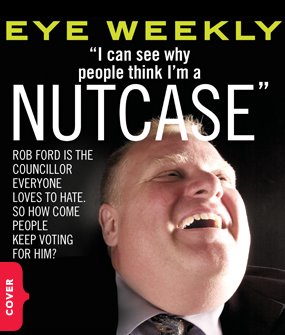
There is no shortage of conspiracy theories in the world today, and this one certainly pales in comparison to the ominous “end times” talk going ‘round, but how can it be a coincidence that, on the very day that Mel Gibson (allegedly) delivered himself of a crazed, alcohol-fuelled rant, Toronto Councillor Rob "Matt Foley" Ford was the cover subject of the Toronto Star’s Eye Weekly magazine?
From the Eye profile, for the benefit of those who had forgotten (or missed it the first time):
May 2006: A complaint is filed with the city's integrity commissioner that Rob Ford, drunk at a Toronto Maple Leafs game, was abusive to neighbouring spectators, shouting "You right-wing communist bastards," "Green Party fucking rules," before being ejected from the game. Ford initially tells reporters, "I wasn't even at the game, so someone's trying to do a real hatchet job on me." The next day, he admits he's lied (while denying some specifics): "I'm going through a few personal problems, but it doesn't justify, you know, getting drunk in public and acting like an idiot, if you ask me."
Pass out the tin foil hats.
Subscribe to:
Posts (Atom)