Wednesday, March 22, 2006

Sorbara: Yes, I was the Gary Ewing of the family

After Greg Sorbara’s resignation in October, I blogged that his claim of non-involvement with the family real estate business was somewhat at odds with his self-description as a “successful businessman” when running in a 2001 by-election to return to the Ontario Legislature (see “Greg Sorbara: ‘successful businessman’ or Gary Ewing?).

On March 13, the Globe published this (subscription required), in a story about Sorbara’s attempt to have a court remove his name from RCMP warrants executed on his family’s business premises last fall:

Even though he received a salary of $40,000 a year from Sorbara Group, he said his older brothers, Edward and Joseph, made it clear "that I ought not to contemplate becoming involved in the management and direction of 'their' business," Mr. Sorbara says in the court document.

By the time he became president of the Ontario Liberal Party in 1999, he had sold off the baseball and carpet investments and began devoting most of his time to politics.

One so rarely gets a straight answer to the question, “were you lying then, or are you lying now?” I guess this settles it; he was lying then – when he was asking his neighbours for their vote in 2001.

New battle front opens up on Sorbara: pension fund sues over his Royal Group role

On the eve of Dwight "Spanky" Duncan's first budget as Ontario finance minister, Greg Sorbara’s road back to that job has just had another sinkhole appear, namely a $1-billion class action lawsuit against him and other Royal Group figures, stemming from his 10-year tenure as an independent director of the Woodbridge-based firm. The National Post reports:

Former Ontario finance minister Gregory Sorbara and company founder Vic De Zen are among eight former and current officials with Royal Group Technologies Ltd. named in a $1-billion class-action lawsuit filed in an Ontario court.

The Canadian Commercial Workers Industry Pension Plan claims that Royal Group and the eight company officials were "oppressive" and "unfairly prejudicial" to shareholders because they failed to disclose a series of related-party transactions that ultimately triggered an ongoing criminal investigation.

"Mr. De Zen always viewed Royal Group as 'his' company, despite the massive amount of capital invested in the company by the plaintiff and many others," the claim alleges.

Mr. Sorbara and two other defendants, Ralph Brehn and Ronald Slaght, sat on the audit committee of Royal Group's board and should have exercised "heightened vigilance" in monitoring the company's actions, especially in light of Mr. De Zen's voting control. Mr. De Zen converted his multiple-voting shares to subordinate voting shares last June.

At least five U.S.-based law firms have filed new class actions in the U.S. federal court, seeking relief on behalf of U.S.-based shareholders only. Yesterday's filing marks the first shareholders' class action filed against Royal Group in a Canadian court.

The pension plan, based in Campbellville, Ont., bought shares of Royal Group between Feb. 26, 1998, and Oct. 18, 2004. It claims $700-million in actual damages plus $300-million in punitive damages because, among other things, the company and the executives named allegedly overstated financial results and failed to disclose investigations into related party transactions.

Also named as defendants are Gary Brown, a former director and chief financial officer; Dominic D'Amico, a founder and "significant shareholder" of the company; Douglas Dunsmuir, a former chief executive and director; and Ron Goegan, a former chief financial officer.

The Canadian Commercial Workers’ plan is not the only pension fund that may have been burned on their Royal Group holdings. As I blogged on October 17th (see “Sorbara’s Plea: Incompetent but Innocent”), other owners of Royal Group shares included the working stiffs who contribute to the Canada Pension Plan and Ontario Teachers Pension Plan (N.B. Royal Group's symbol is "RYG". CPP holdings are under "Mutual Fund Ownership" and Teachers’ holdings are under “Institutional Ownership” on the MSN site).

When the Ontario Securities Commission notified Royal Group of its investigation in December, 2003, the Ontario Public Service Employees Union (OPSEU) Pension Plan held about 750,000 shares, but no longer owns any shares.

Royal Group recently announced that it won't meet the March 29 deadline for reporting audited 2005 financial results, and may have to restate reports for previous periods.

The last we heard from Sorbara, he was denying that he leaked news of a TTC subway expansion to a local politician. Days before, he was trying to have his name removed from RCMP warrants executed at his family's business offices last fall in connection with the Royal Group matter. It's not clear how far this new suit will go, but having to defend this lawsuit at the same time he is trying to clear his name with the RCMP will likely add additional mental and financial burdens.

A few weeks ago I ran into a longtime Woodbridge resident of of Mr. Sorbara's generation. He was firmly of the view that Sorbara will not run again.

Tuesday, March 21, 2006

Failure to kvetch: StatsCan says parents mostly okay with adult kids at home

With the Sarah Jessica Parker-Matthew McConaughey rom-com Failure to Launch at number two in the box office, Statistics Canada has made a timely release of a 2001 study about parents living with at least one adult child at home. (People magazine says McConaughey is the Sexiest Man Alive, but, like most of their picks, he does nothing for me).

Some excerpts from StatsCan’s summary of the study:

The majority of parents living with at least one adult child at home expressed no sign of frustration about their living arrangements, according to a new study published today in Canadian Social Trends. But that does not mean there was perfect harmony in all these households.

Most parents agree that having children has made them happier people, and co-residence does not modify that opinion. On the contrary, parents living with at least one of their adult children were more likely to be very satisfied with the time they spent with their children.

However, the study did find that having children at home increased the frequency with which the parents report having arguments with their spouse over subjects such as money, chores and responsibilities, and the children.

Cultural factors were also associated with co-residence of parents and their adult children. Parents born in Asia and South or Central America were more likely to co-reside with their adult children than those born in Canada. This was especially the case for parents who had immigrated to Canada recently. For example, the probability that an Asian-born parent who came to Canada between 1980 and 2001 lived with at least one adult child was 82%.

Finally, parents who themselves had left home at a younger age were less likely to live with their adult children. Parents who left their own parents' house in their teens or early 20s may have provided an example for their own children or, alternatively, could have encouraged their children to leave home earlier.

This message brought to you by Promise Breaker McGuinty

Sunday night seems to be the night for premieres of new McGuinty government TV commercials. Two nights ago was the first time I had the pleasure of viewing their latest, a spot touting the benefits of English language training for immigrants. You don’t say. . .

Monday, March 20, 2006

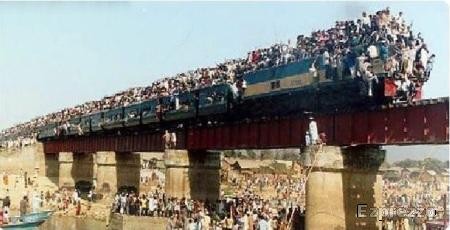
“Dinner is now being served in the dining car …”


Is still one of my favourite sight gags from the Simpsons. It’s in the episode where Apu Nahasapeemapetilon gets fired from the Kwiki-Mart. Homer then accompanies Apu on a pilgrimage to the Kwiki-Mart HQ in India in an attempt to get his job back. (The episode also features the classic song “Who needs a Kwiki-Mart” and James Woods filling in at the store as research for a film role.)

Anyhow, I was reminded of that gag when I saw this photo at Exprezzo.com (hat tip: Lucianne.com) . In the Simpsons episode, the passengers hanging onto the side of the train start suffling forward – presumably toward the dining car – when the dinner announcement is made.

Friday, March 17, 2006

Go figure: government day care workers on strike

Did you know that day care workers are on strike in Montreal? No? Neither did I, until I read about it last week in William Watson’s column, buried on the last page of the Post’s business section. To be fair, they are only on strike for an hour a day, as Watson writes:

They don't show up for the first hour of the day. This is not to inconvenience parents, they insist, but to put pressure on the provincial government to pick up the pace on implementing a pay-equity settlement brought down last year by the tribunal that handles such things.

Of course, the only way to pressure the government is to inconvenience parents so they'll complain enough to government that it relents and uses (by and large) non-parents' money to pay for daycare. If the non-inconvenience of arriving one hour late doesn't work, they plan to start arriving two hours late -- until things become so non-inconvenient that the government caves. (In fairness, workers in the Laurentian region north of Montreal voted not to join in the pressure tactics. Good for them!)

It's a classic People's Republic of Quebec unholy trinity: public management of an important service, unions run amok, and pay equity. The union's view is that mainly female daycare workers who earn $19.55 an hour should actually be making $21.78 an hour. Why is that? Because men doing entirely different things are paid $21.78 an hour. It's a question of fairness, you see.

"But it's entirely different work," you say. How naive of you! It may not be exactly the same work. Actually, it may not be remotely similar work. But it is work ... of ... equal ... value.

You might think that the media in English Canada would throw some light on this, given: (1) it is less than two months after an election partially fought on the child care issue, (2) the Harper government has named their $100/month child care promise as one of their top five priorities, and (3) the other three parties in Parliament are holding fast to their dreams of a Quebec-style system for all.

My Google search suggests that this story has not broken outside of the Quebec media. Now why wouldn’t journalists want parents in Ontario to know what government day care looks like when it’s delivered by unionized workers? I simply can’t imagine . . .

Compare this radio silence to the wide coverage received today by a YWCA "study" that claims all families want a government day care system. The survey was based on chats with around 100 people, apparently drawn from the YWCA's own client groups, in four communities. A look at the study's "expert panel" reveals the usual big-government day care suspects, er, advocates: Martha Friendly and Kerry McCuaig. (I will read the full report and may be blogging further on it.)

A nice companion piece to this apparent non-story of the day care strike is last week's item about how two day care workers in Laval (that's also in Quebec) left an sleeping infant alone in a day care centre having locked up and gone home at 6:00 p.m. Amazingly, they were fired.

Thursday, March 16, 2006

McGuinty dons Promise Breaker mantle again

Journalists have started shining a harsh light on the McGuinty regime for their new crop of government-paid television advertising. Christina Blizzard is the first out of the gate, with a column in Wednesday’s Toronto Sun.

The award for the most money spent on government advertising during the recent Oscars broadcast? The envelope, please. Thank you, ladies and gentlemen: A round of applause for the Government of Ontario.

Yes, you lucky taxpayers. You and your hard-pressed tax dollars, were front and centre during the Academy Awards on March 5.

Remember their ads? You know, the cute one with the darling little baby selling the virtue of immunization and the government's new vaccines? And the one that tells us to quit smoking? Then there's the tourism ad that sells the virtue of visiting Ontario -- to Ontarians.

There were five 30-second spots in all. Two for tourism, two for health and one smoking cessation ad was for the Ministry of Health Promotion. The cost to air them on Oscar night was $44,000 per spot -- for a grand total of $220,000.

As Blizzard notes, among the most highly touted of the Liberals’ 200-plus election promises was this pledge: “We will implement the McGuinty bill to ban self-promotional government advertising and authorize the provincial auditor to review and approve all government advertising in advance.” This promise grew out of the Liberals’ moral (cough) indignation at the Harris government using government-paid TV ads to tout, among other things, their education reforms and health care spending.

According to the Liberals, the auditor approved the McGuinty government ads, leading to the reasonable conclusion that the Harris ads would also have passed muster, as they were no more “partisan” than the Liberals’: they, too, promoted government initiatives, not members of the government or the PC party.

I remember an occasion during the Harris years, when one of Harris’s top strategists mentioned that some of the PC MPPs expressed discomfort with the government-paid ads. His response to the MPPs was “We can stop them, but it would be like cutting off your oxygen.” Looks like the McGuintyites have come to the same conclusion. But I would argue that their hypocrisy, after having explicitly run against the concept of government advertising, sets them apart from the conservatives.

The tally of McGuinty broken promises is now somewhere north of 50.

As I have noted elsewhere (see "Reflections on the Revolution"), many of the Common Sense Revolution’s themes and policies have survived the conservatives’ defeat, but the next big test will be the October 2007 general election. Then we will find out if it is important for a government to fulfill the platform it ran on, or whether other issues will rate higher in voters’ minds.

Among the journalists most critical of the Harris ads was The Toronto Star’s Queen’s Park columnist Ian Urquhart. He is off this week, but look for him to weigh in on this issue soon.

Wednesday, March 08, 2006

Broadcast Council response to complaint re McGuinty appointee

Yesterday I received the following e-mail from the Canadian Broadcast Standards Council, in response to my complaint about news channel CP24. The complaint is detailed in my February 20th post, "Conflict of Interest Complaint re McGuinty Appointee." My e-mail in response to the CBSC is also below.

Dear Mrs. (sic) Tintor,

The Canadian Broadcast Standards Council (CBSC) has received your correspondence concerning news anchor David Onley which is broadcast on CityPULSE 24.

Please note that the CBSC is unable to deal with the December 6th interview (since broadcasters are only required to hold copies of the logger tapes for a period of 28 days following the broadcast).?However, we will be dealing with the February 7th broadcast.

Therefore, by copy of this email, we are asking CityPULSE 24 to respond to the concerns you have raised and to hold a copy of the logger tape of the broadcast which concerned you. This is always the first step taken by the CBSC in pursuing a complaint. You should know that broadcasters who are members of the CBSC take their responsibility to respond to audience concerns very seriously. The dialogue between broadcasters and members of their audience is a cornerstone of the CBSC's complaints resolution process. Concerns are often resolved satisfactorily through this dialogue phase. We hope that the response you will receive from CityPULSE 24 within the next 21 days will resolve the issues you have raised to your satisfaction. If, however, after you have received and carefully considered the broadcaster's response you remain concerned, you may request a Ruling by a CBSC Panel by filing the form available on our website at http://www.cbsc.ca/english/complaints/rulingrequest.htm. You should do so within 14 days of receiving the broadcaster's response. More information on the CBSC complaints process is available on our website in the FAQ section (http://www.cbsc.ca/english/faqs/index.htm).

The CBSC is a national voluntary self-regulatory organization created by Canada's private broadcasters to deal with complaints made by viewers or listeners about programs which they have seen or heard broadcast on a member station.?The CBSC administers four industry codes, namely a code of ethics, a code concerning television violence, a code concerning sex-role stereotyping and a code of journalistic ethics, which set out the guidelines for television and radio programming.

Sincerely,

Nicole Lafrance
CBSC Correspondence Officer

****************************************************************************

From : joan tintor
Sent : March 8, 2006 8:01:28 PM
To : nlafrance@cbsc.ca
Subject : RE: Your complaint concerning conflict of interest (CBSC File C05/06-1200)

Thank you for your response to my complaint.

I would like to reiterate that the substance of my complaint is not any particular broadcast or interview in which Mr. Onley participated or may participate in in the future, but the continuing conflict that arises from his being a political appointee of the Ontario government at the same time that he is an anchor who reports news and interviews public figures.

Thank you for dealing with my complaint and I look forward to CP24's response.

Joan Tintor

Saturday, March 04, 2006

1st Lt. Garrison on the state of democracy in Iraq

Note: 1st Lieutenant Micah J. Garrison has been serving in Iraq for ten months. He and his unit hope to be home by the end of May.

I've had quite a few people ask my feelings about the state of the Iraqi government, are things really close to a civil war following the mosque bombing from a couple of weeks ago, questions like that. I've decided to try to put things into perspective a little, but of course, these are some of my own opinions and ideas on the state of politics in Iraq.

Things really don't seem that different on our end, on patrol working with the Iraqi people, following the mosque bombing and continued violence. Violence has been a part of the Iraqi way of life for many years, and unfortunately there doesn't seem to be an end in sight any time soon. There will always be bad Iraqis, just like there will always be bad Americans. Unfortunately the bad people here use elevated forms of violence in the forms of suicide bombers, car bombers, drive by shootings, and other types of violence that we aren't accustomed to as Americans. Many of the insurgents we’ve captured weren’t shooting at us or putting in IEDs because they don’t like Americans, but because it’s the easiest way for them to make money, as they get paid large sums of money to carry out attacks. A lot of non-Iraqi insurgents have also been captured who are here for no other reason other than to promote and cause violence because they don’t want to see democracy succeed.

The level of violence and death these people have had to endure is difficult to comprehend. Every Iraqi has had someone they cared about killed due to violent conflict during the last 25 years. Look at the numbers. During the Iran/Iraq War of 1980-1988, an estimated 450,000 - 950,000 Iraqi military deaths. This number doesn't include the countless civilian deaths. During the Gulf War of 1990-1991 an estimated 25,000 - 100,000 military casualties were suffered. And we don't even have clear numbers for the latest invasion. These people have been in a constant state of war and turmoil for most of the last 25 years. It has sadly become part of their culture.

Many of the older Iraqis we have encountered don't really seem to grasp the opportunity they now have as free Iraqis. I remember talking to one tribal chief and he kept saying, “What can I do” or “I can do nothing” when I kept asking for information on insurgents and why he wasn't leading his people to support and embrace democracy. Here I was trying to explain to a guy 2 or 3 times older than me what he should be doing as a leader and what freedom truly meant and how his people looked to him for guidance because people want to be led. I was extremely frustrated about this encounter until I reflected later that he didn't know what freedom was. He hadn't grown up in a free society, nor did he understand that democracy is what the people make it.

On the other hand, most of the younger Iraqis (late teens to 30s) seem to truly grasp the idea of democracy and understand some of what lies before them. They seem more willing to work with us and take the initiative to make their country better. I think this is due not only to the "exuberance of youth" but also to the fact that they haven't been oppressed for as long as the older Iraqis have been and haven't seen or experienced as much violent government action. If they can keep things together long enough for the younger generations to grow up in a free society I think they have a good chance of making it work. When we go on patrol the kids love to see us and wave and smile but in some cases the adults don't really care for us. Why? Because the adults have seen and experienced the war first hand for most of their lives and don't really know what to expect from democracy.

Of course, there people back home that say things like: what about the corruption in the Iraqi government, Army, or police, or, why is it taking them so long to form a government, or, if Saddam was so bad then why do some Iraqis wish he was still in power. I think many questions like this would be easily answered if people would try to be empathetic with the experiences of the Iraqi people and also look at things from a historical perspective. First, there is corruption in some shape or form in just about every type of government in the world. Unfortunately things here are just under a microscope. As the saying goes, power corrupts, and absolute power corrupts absolutely. The Iraqi government is just going through the same growing pains every other newly formed government has gone through. After the fall of communism in the former USSR corruption was rampant, but over the years a more stable government has slowly evolved.

I also think that most people don't seem to understand that you can't just snap your fingers, form a new government, and have everything work like you want. Take the timeline for the formation of our own government for example. The Declaration of Independence was signed July 4, 1776. The Articles of Confederation were proposed on November 15, 1777, but weren't ratified until March 1, 1781. The Treaty of Paris officially ended the Revolutionary War on January 14, 1784, but the final draft of the Constitution wasn't sent to Congress until September 17, 1787, wasn't ratified until June 21, 1788, and didn't take effect until March 4, 1789. It took 13 years for the fledgling American colonies to draft a document uniting them under one federal government. I admit that the American situation and the Iraqi situation are quite different, but I hope my example makes sense. For a nation to try and develop and implement a form of government it has never experienced before while at the same time trying to govern and fight an insurgency is an extremely difficult and trying process. To be honest with you I'm somewhat surprised they've done as good a job as they have.

I'll use one more example to respond to some of those people who want to know why some Iraqis wish Saddam was still power. I think that is easily explained by human nature. Humans tend to want to do whatever is comfortable or to leave things as the status quo. That is why it is so difficult to change the status quo, especially when it comes to government. People may not always like the results of what they currently have, but there isn't that scary "unknown" or "what if" factor if they were to pursue political change. Humans are also inherently lazy when it comes to self-rule and are more willing to accept inconveniences if it means they don't have to face unknown fears or put their own hard work into changing things. I think history also proves this point. Any time a group of people undergoes significant change as a society there will always be those who wish things could go back to the way they were. Why? Because they knew what to expect. When Moses led the Israelites out of Egypt some wanted to go back. During the Revolutionary War there were many colonists who remained loyal to the British Crown and sided with the British. Following the reunification of Germany I remember reading articles about how some Germans (both East and West) wished they were still separated. Following the fall of Communism in the former USSR there were many people who longed for the return of Communism because of the rampant corruption in the newly formed Russian Government.

I'm also somewhat frustrated because it seems that many news agencies, politicians, and other foreign governments either expect or hope the democracy project in Iraq will fail and I'm not really sure why. Having grown up in America and having been blessed with the freedoms we have, I wish people of other nations could have the freedoms and quality of life that we enjoy.

I hope these examples answer the questions that some of you have asked. Again, what I've discussed here is strictly my own opinions. I wish I had more time to cite more examples and give better explanations of what I see happening here, but spare time is limited for me. I also realize that some of my arguments are somewhat elementary in scope, but it’s the best I could to with the time I have.

We should only have about 8 weeks left here, but we still don't know an exact date. I look forward to seeing all of you when I return home. Thanks again for your continued support. Micah.

1LT Micah J. Garrison
HHC TF 2-130 Infantry
Recon Platoon
APO AE 09381

Thursday, March 02, 2006

TO Star holds out football for Kennedy to kick – again

Even before Ontario education minister Gerard Kennedy entered the Legislature after a May 1996 by-election, The Toronto Star was already boosting the food bank director and political neophyte as a potential replacement for Lyn McLeod. The story reporting his by-election win in Bob Rae’s former riding of York South noted that the victory was “expected to launch his campaign to become provincial party leader.” (An interesting footnote is that the NDP candidate was then-Toronto councillor and future mayor David Miller. The PC candidate was City of York councillor Rob Davis.)

Barely a month after his election, a glowing profile of Kennedy, entitled “The Rookie” appeared on page 1 of the Star’s Life section. Three weeks later, Kennedy was a declared candidate. Despite his scanty experience, Kennedy garnered the support of heavy hitters such as long-time MPP Gerry Phillips and Peterson-era finance minister Bob Nixon.

Kennedy enjoyed a paper lead after the delegate selection meetings, having elected the most delegates committed to vote for him on first ballot. A week before the November 30 vote, the Star endorsed Kennedy in an editorial: “Kennedy also possesses – unlike the outgoing leader, the sincere but plodding Lyn McLeod – the vision and the charisma so essential to winning an election. He has a proven ability to attract and inspire people of differing backgrounds to a public cause.”

But three days before the vote, a story appeared on page 11 of the Star, titled “Liberal camps gang up in bid to stop Kennedy: Question loyalty of frontrunner in leadership race.” Queen’s Park bureau chief William Walker reported that “top candidates for leader of Ontario's Liberal party appear to be ganging up on frontrunner Gerard Kennedy in a last-ditch attempt to block a victory by the 36-year-old rookie MPP.”

Then on the day of the vote, a bombshell: a front-page Star story entitled “Frontrunner Kennedy target of surprise attack: Letter from executive of own riding urges Liberal delegates not to back him.” The story reported that Kennedy was the target of a scathing attack from members of his own York South Liberal riding association executive. The executive had distributed more than 1,000 letters to delegates on the convention floor the previous night, urging them not to vote for Kennedy.

Despite last-ballot support from Dwight Duncan – who enjoyed the support of a gaggle of MPPs – Kennedy was edged out by Dalton McGuinty, who enjoyed the support of Tony Ruprecht (and had placed fourth on the first ballot). Due to incompetence on the part of vote organizers, the final ballot was not announced until approximately 4:00 a.m.

Now the Star is boosting a Kennedy candidacy again, this time for federal Liberal leader. On Wednesday, in a story entitled “Liberals eye education minister,” Queen’s Park columnist Ian Urquhart reported that:

Kennedy acknowledged today that he’s spoken privately with supporters about entering the federal Liberal leadership race but said he isn’t making any plans to do so — yet. “People have approached me; I’ve been respectful,” Kennedy said before a cabinet meeting at the Ontario legislature.

Again, Kennedy is being touted by a cabal of heavy hitters, reportedly Senator Terry Mercer, a former national director of the federal Liberals, community activist June Callwood, and writer-philosopher Mary Jo Leddy.

Will Kennedy come running for the Star football again? Or has he learned through bitter experience not to get high on the ink of his Star clippings? Only time will tell.

Tuesday, February 28, 2006

Take back our public services

In light of recent events, I thought it would be timely to re-post an updated version of this op-ed, which won third place in last fall's Western Standard editorial contest.

In Montreal, a city roads crew was caught spending just six minutes of its nine-hour shift fixing three potholes. In British Columbia, teacher unions are contemplating another illegal strike, just four months after their last one. In Ontario, CUPE President Sid Ryan threatened that municipal workers who clean schools, plow roads and pick up garbage would walk off the job, in protest against the McGuinty government's pension legislation. (A last-minute resolution averted the wildcat strike.)

Organized labour has some clever slogans about all the good it has done for society, such as “Unions: the people who brought you the weekend.” But what have they done for us lately?

Think of the state of our roads, the quality of our education and health care, the cleanliness of our streets. The overall tax burden has grown, but this has hardly been matched by an increase in the quality of government services. Yet the wages and benefits of public sector workers continue to rise. Of course they do: by their very nature, public sector unions tend to drive up the costs and size of government. Union dues – themselves a cost driver – go to employ officials whose full-time work consists of filing grievances, lobbying the government for more workers, coordinating with other unions and supporting sympathetic candidates.

Much of the impetus for contracting out the delivery of public services stems from roadblocks faced by politicians attempting to meet the demands of taxpayers or deliver on good-faith election promises. Unions label such activity "privatization," but it's not. From their point of view, it's de-unionization. Scratch the surface of any of the recent campaigns against health care reform, and you will find that most are organized and funded by unions. They oppose health care reform because they are afraid it will result in new services or facilities outside the current unionized health care sphere.

Of course, nothing is preventing unions from attempting to organize workers in non-unionized facilities, but after 30-odd years of public sector unionization, a sense of entitlement takes hold. And it's easier to protect existing union turf by holding citizens and politicians hostage through work-to-rule and illegal strikes, than to convince non-unionized workers it's worth handing over part of their paycheques to Sid Ryan et al.

Since public servants began to unionize, the public has gradually lost control of its public services. Some have argued for outlawing strikes by teachers and other public sector workers, but this would be mere tinkering. The only way for the public to take back control of the services it owns is by decertifying public sector unions and restoring a direct employment relationship between government workers and democratically elected governments. Here’s why it makes sense:

Once the public has decided that a particular service is to be provided by the government, then that service is, by definition, essential. Many try to make a distinction between services that relate to safety and other government services. But public schools, transit and most other public services are legally or effectively monopolies, in that most citizens have no practical alternative when those services are not available.

Public sector collective agreements take away the public’s democratic right to decide what public services are to be delivered and what terms of employment are to be offered (provided those terms comply with employment standards laws and the common law). The wages, benefits and working conditions of public sector workers should be open to the democratic process as are all other aspects of government. They should not be decided in backrooms in negotiations from which the public is barred and on which the public’s elected representatives are forbidden to comment.

It is not the role of government to engage in unfair labour competition with the private sector. Some people think it is noble for the government to “set an example” for the private sector through higher wages and benefits. Such people don’t understand economics. The increasing taxes that those business will have to pay to support the government’s “example” mean that they will be hard-pressed to pay the employees they already have, let alone pay them more.

Thousands of private firms have policies and procedures for dealing fairly with employees; so would a union-free public sector. If the public through their elected government provides wages, benefits and working conditions that can’t compare with private employers’, then it will find itself with fewer and less capable employees.

Public sector workers would continue to be free to advocate for themselves through the democratic process. But those who interfere with the provision of government services will, like private sector workers, be subject to the appropriate civil or criminal sanctions. Those who fail to show up for work will not be "on strike," they will have quit.

Let’s put the “public” back into the public sector, by putting citizens and their elected representatives back in charge of our public services.

Friday, February 24, 2006

My sister would relate: man kills neighbour over door slamming

I noticed this item on Drudge, about a Florida man whose motive for killing his neighbour was apparently her slamming of her door late at night.

When I lived with my late sister in a townhouse in Mississauga, our next door neighbour would slam the door loudly when he left for work in the morning. I rarely noticed it, but it really irritated my sister, who slept in the front bedroom. I never contemplated killing the guy, but my sister probably did.

This neighbour was a rather bizarre fellow who once gave me the fright of my life when I spotted him walking his dog in full Klingon regalia (him, not the dog). On another occasion, my sister and I arrived home to find his Hyundai in its parking spot, with its front wheels on blocks and the engine running at full tilt in park (or neutral?). I wondered aloud what the purpose of this was, and my sister speculated that perhaps he was trying to get it into warp drive.

On the morning of her funeral -- which was a Saturday -- I had to leave very early to meet my family at my mother's house. In my sister's honour, I slammed our door as loud as could. I hope it woke him up.

Wednesday, February 22, 2006

McGuinty Memory Lane on Illegal Strikes

In October 1997, Ontario teachers staged an illegal strike (which they billed as a "political protest") against the Harris government's Bill 160. The bill was designed to move education dollars from administration to the classroom by, among other things, requiring teachers to teach an additional half-class per day. The teacher unions' spin was that the bill was designed to allow the government to cut education funding (a specious argument: the government did not require legislation to change the level of grants provided to school boards).

Dalton McGuinty had been leader of the Ontario Liberals for less than a year. Seeking to establish his credibility on education (and perhaps curry favour with teacher unions) McGuinty wholeheartedly endorsed the illegal strike, even appearing at a teacher union rally at Queen's Park. The teacher unions, sensing public support was waning, ended the illegal strike after two weeks.

That was then . . .

"I understand it's not easy. But take heart in knowing you are doing the right thing."
--Dalton McGuinty, Teachers' Rally at Queen's Park, October 29, 1997

". . . I'm . . . saying right here before you that I'll be with the teachers. . . . This strike may very well be technically illegal. . ."
--Dalton McGuinty, Focus Ontario, Global TV, October 18, 1997

"If they walk out, I'll be with the teachers."
--Dalton McGuinty, Focus Ontario, Global TV, October 18, 1997

. . . This is now

I believe that CUPE in particular has every right, and I fully respect and support that right, to protest any action on the part of our government, but at the same time, I think it is wrong to engage in an illegal activity to register that protest.

I think it's wrong, because you're angry with the government, to take it out on Ontario families. I think it's wrong, because you're angry with the government, to keep kids out of school. I think it's wrong, because you're angry with the government, to stop plowing our roads. I think it's wrong, because you're angry with the government, to stop picking up our garbage. I think it's wrong, because you're angry with the government, to stop providing those important services we all count on.
--Dalton McGuinty, Question Period, February 21, 2006

Monday, February 20, 2006

Conflict of Interest Complaint re McGuinty Appointee

David Onley is an anchor at news channel CP24 and long time advocate for the disabled, being disabled himself. He is also the recently-appointed (as of December 2005) chair of the McGuinty government’s Accessibility Standards Advisory Council, a part-time position paying $225 per diem.

Unfortunately, doing both jobs puts him in an obvious conflict of interest as a journalist. Clause 5 – News of the Code of Ethics of the Canadian Broadcast Standards Council says:

“It shall be the responsibility of broadcasters to ensure that news shall be represented with accuracy and without bias. Broadcasters shall satisfy themselves that the arrangements made for obtaining news ensure this result. . . . Broadcasters shall refer to the Code of Ethics of the Radio and Television News Directors of Canada (“RTNDA”) for more detailed provisions regarding broadcast journalism in general.”

According to Article Six (Conflict of Interest) of the Code of Ethics of the RTNDA, “Broadcast journalists will govern themselves on and off the job in such a way as to avoid conflict of interest, real or apparent.”

Being a paid advisor of a sitting government you report on sounds like a clear conflict to me. But if journalists and news outlets won’t behave ethically, then somebody has to bring their behaviour to the attention of the bodies whose job it is to ensure that they do.

You can e-mail your complaints to the Canadian Broadcast Standards Council here and the Radio-Television News Directors Association here. I sent the following complaint:

To: the Canadian Broadcast Standards Council and Radio-Television News Directors Association:

I believe that cable news station CP24 is in violation of the RTNDA’s Code of Ethics, due to the fact that one of its anchors, David Onley, has accepted an appointment to advise the Ontario government, yet continues to read news and conduct interviews on CP24, including interviews with ministers of the government that appointed him.

The position is Chair of the Accessibility Standards Advisory Council, an appointment made by the Minister of Community and Social Services, for which Mr. Onley will be paid $225 per diem (it is a part-time position). The details of the council and Mr. Onley’s appointment are at the website of the Ontario government’s Public Appointments Secretariat (http://www.pas.gov.on.ca/scripts/en/BoardDetails.asp?boardID=141221). The December 13 release announcing his appointment is at the website of the Ontario Ministry of Community and Social Services (http://www.mcss.gov.on.ca/CFCS/en/newsRoom/newsReleases/051213.htm.)

On the afternoon of Friday, December 16, 2005, Mr. Onley conducted an on-air interview with Ontario’s Minister of Health. On the afternoon of February 7, 2006, Mr. Onley conducted an on-air interview with Ontario's Attorney-General. As of February 20, 2006, Mr. Onley was still performing anchor duties at CP24. The Code of Ethics of the RTNDA states, under Article Six, “Broadcast journalists will govern themselves on and off the job in such a way as to avoid conflict of interest, real or apparent.” I believe that Mr. Onley’s provision of paid advice to the Ontario government is a clear conflict of interest with his duties as anchor on a news channel.

Thank you for your attention.

Joan Tintor


With a sizeable cohort of former broadcast journalists on staff (e.g. Matt Maychak, newly-anointed Toronto-Danforth candidate Ben Chin, Leon Korbee), odds are the McGuintyites know this is less than copasetic, but think they can get away with it. Onley’s on-air interview with McGuinty’s health minister George Smitherman three days after his appointment suggests that Onley thinks he can get away with it too.

This situation brings back memories of McGuinty’s first hire after he was elected Liberal leader in 1996: his kid brother Brendan. Ontario Legislature rules are explicit that MPPs can’t hire relatives. McGuinty tried to get around it by making his brother an employee of the Liberal caucus services bureau, though he made it clear that Brendan would be working directly for him, telling reporters, “he’ll be of great assistance to me, to have somebody on staff who will be completely truthful.” (I guess his non-sibling staff were all liars), and “I can always count on him ... to tell me when I’m doing something stupid.”

After it blew up in his face, McGuinty cancelled his plans to hire Brendan and blamed the public, telling the Toronto Sun “I regret that I underestimated the extent to which my brother’s appointment would be misinterpreted.” Brendan eventually ended up back in Ottawa, where he spent several years as a top staffer to Ottawa mayor and former Liberal MPP Bob Chiarelli.

Wednesday, February 15, 2006

Update from a soldier serving in Iraq

Note: 1st Lieutenant Micah J. Garrison has been serving in Iraq for nine months. He and his unit hope to be home by the end of May. He came to my attention through a piece he wrote for AccessNorthGa.com, in response to comments by Senator Hillary Clinton about body armour.

Hello everyone. I hope all of you have had a happy Valentine's Day. I'm sure Hallmark has had a pleasant February 14. Today marks our 14th month away from home and our 9th month in Iraq. It's hard to comprehend how much time that is. My wife Tara put it into perspective in a recent conversation. We bought a house in May of 2004 and in September bought a Boston Terrier puppy to keep her company while I was deployed. Tara recently said, "It's sad that Bailey (our dog) has lived in our new house longer than you have." It's kind of funny to me when I look at it like that. We're definitely looking forward to coming home, but we still have a lot of work to do here.

At times it is very rewarding and we feel great about what we do and at other times it is extremely frustrating and makes you angry. I and two of my men were on a recent three day mission (yes, it was extremely cold) to try to catch insurgents putting in IEDs (roadside bombs) in an IED heavy area. We watched in frustration and anger when, less than twelve hours apart, two different patrols were blown up right in front of us because they wouldn't listen to what we told them on the radio. We were less than 400 meters (about 1 1/3 football fields) away from them when they blew up.

The two IEDs resulted in three casualties, one of which was fatal. It was frustrating because the IEDs had already been put in before we got there and we missed our chance to take out the bad guys. It was also frustrating for us because the patrols didn't listen to what we tried to tell them and we had to watch as they got blown up. We did help call in security and medical assets on the radio, so we did what we could to help afterward. This makes several IEDs we've been very close to when they exploded. The explosions were quite large and very loud. At least now I'll have something to blame my selective hearing (oops, I mean hearing loss) on when I get home.

The reason I've been sending these e-mails is because the most common question I get is "what is it like to be there?" While I'll never be able to fully put into words or express what it has been like, I have tried to explain and describe some of the things Infantry soldiers experience over here and what it takes to insure the freedoms we enjoy as Americans. I hope that I have portrayed some of these feelings and experiences to all of you. Tara said that at least I'll have some new stories to tell when I get home, but I'm sure she'll get tired of them soon enough. We're not exactly sure when we're coming home yet, but we're fairly confident that we're down to a double digit number. We've already started some of the initial work required before we can return (equipment accountability, countless inventories, etc), so we know we're finally getting close.

Our lives have been changed forever by everything we have seen, done, and experienced here. We also realize that we will never take so many things in our lives for granted ever again. It is hard to explain to people how truly blessed we are as Americans to live in the states and enjoy the freedoms we have. If everyone in the states could have walked in our shoes for the last year they would definitely to some re-prioritizing in their lives and wouldn't take so many things, both large and small, for granted.

A quote I read and shared with some of you earlier in my deployment says it best. It says, "You've never lived until you've almost died. For those who fight for it life has a flavor the protected will never know." I hope all of you have a great spring, I'm looking forward to seeing all of you when I return home. Take care, and don't work to hard. Micah.

Update/correction: Several people have asked if the patrols we saw get hit were from our unit. No they weren't. Also, the best way I can describe how it felt would be if you had a front row seat to a train wreck back home and could do nothing about it. We were 300-400 meters away. Obviously that is 3-4 football fields, not 1 1/3 football fields like I said. As a teacher I had in high school used to say, I was just seeing if y'all were paying attention.

1LT Micah J. Garrison
HHC TF 2-130 Infantry
Recon Platoon
APO AE 09381

Monday, February 13, 2006

Smart of NDP to take a buzz saw to Hargrove

I am not normally in favour of political parties stripping people of membership (and in light of recent events, it's lucky for some of us that the Conservative Party and its predecessor entities didn't make a habit of it).

But even though it doesn't reflect well on the New "Democratic" Party, I think it was smart of the Ontario NDP executive to strip Basil "Buzz" Hargrove of his membership, for violating the party's constitution regarding provisions against endorsing other candidates. The move also automatically revokes his membership in the federal party.

You can't blame the NDP for being fed up with Buzz taking a buzz saw to their interests in two general elections in a row now. Hargrove did the exact same thing to them in the 2003 provincial election – advocate voting Liberal to defeat the Tories – which may have played a role in the Howard Hampton-led New Democrats falling one seat short of party status in the election outcome. After enduring 11 weeks of negative publicity for refusing to agree to grant some kind of status to the NDP, Dalton McGuinty relented and allowed the NDP a reduced standing and a research budget. A few months later the NDP got their full status back by taking a seat from the Liberals in a Hamilton by-election. That status is again at risk with the resignation of Marilyn Churley to run (unsuccessfully) in the federal election. The NDP has to win her seat in Beaches-East York to retain their party status.

Buzz Hargrove was also a considerable pain in the bum to former federal NDP leader Alexa McDonough during her tenure. She must be smiling today.

In January, I wondered why the media treated Buzz's endorsement of Martin as big news, considering it was Buzz's second time at the Liberal party, and suggested that the NDP should have a nice bag of quotes next time to inoculate themselves against yet another Liberal endorsement from Buzz. Turns out they decided that wasn't good enough.

No doubt the provincial NDP made the move with an eye to the next Ontario election, scheduled for October 2007. If Buzz tries to pull the strategic voting stunt again, perhaps it will have less impact.

Friday, February 10, 2006

Day Five – A way out or two . . .

David Emerson’s floor-crossing and elevation to cabinet is not evidence of deep-seated hypocrisy on the part of the Harper regime. Nor is it fatal to the Conservative party. But it is a misstep that can and should be fixed, thereby minimizing its long-term effects. Here are two ideas of how to fix it.

Read the rest at Elect Emerson.

Day Five -- Media notes

On Thursday night, TVO’s Fourth Reading – primarily a show devoted to Ontario provincial politics – briefly dealt with the Emerson issue. One of the guests was Senator Hugh Segal. Segal said that he is in favour of legislation that would require floor crossers to seek the approval of their voters, and that he would vote for such legislation, but noted there is no law now.

Read the rest at Elect Emerson.

Day Five -- Media notes

On Thursday night, TVO’s Fourth Reading – primarily a show devoted to Ontario provincial politics – briefly dealt with the Emerson issue. One of the guests was Senator Hugh Segal. Segal said that he is in favour of legislation that would require floor crossers to seek the approval of their voters, and that he would vote for such legislation, but noted there is no law now.

Read the rest at Elect Emerson.

Day Five -- Former Stronach riding president calls Emerson appointment “a mistake”

An Aurora Era-Banner story quoting Stephen Somerville, president of the Newmarket-Aurora Conservative association, is posted at www.electemerson.blogspot.com.